Workplace Heat Kit: Temperature Rules, Heat Plan and Cooling for European Employers (2026)
An 8-chapter kit you read online or print, with two spreadsheets, for employers and managers in Europe who must assess heat at work and have a plan before the next heatwave: offices, shops, workshops and outdoor work.
- 8chapters
- 31worksheets and tables
- 20checklist items
- 22official sources cited
Checked before every release
- 54automated testsrun at every release: prices, links, pages and data checked before publication.
- 22primary sourcesevery rule and number linked to the official text, for you to open.
- October 30, 2026editionrules and numbers checked on this date, updated when a text changes.
Built from the texts and data of EUR-Lex, Légifrance, BOE, Commission européenne (Eurostat).
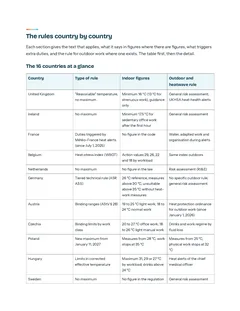
The EU sets no maximum working temperature, but every employer must assess heat and act on it, and each country adds its own rule: binding ranges in Spain and Austria, a tiered rule in Germany, a heat-stress index in Belgium, duties triggered by heat alerts in France, a new maximum in Poland from 2027, stops of outdoor work in Italy, Greece and Cyprus. This kit gives you the rule where you work and the documents to apply it.
Every national rule names its text (Directive 89/654/EEC, the German ASR A3.5, the Spanish Royal Decree 486/1997, the French decree of May 27, 2025, the Belgian Code on well-being at work…) and was checked on October 30, 2026; running costs use Eurostat business electricity prices; the one study cited has its DOI. We do not sell air conditioners, consultancy or installation: the kit is independent.
€39
Get the guide, €39Read chapter 1 free- 8 chapters (about 10,500 words): the European frame, the rules country by country, measuring heat, the risk assessment, the heatwave plan, outdoor and construction work, cooling offices, shops and workshops, the templates
- 31 worksheets and reference tables, including the 16-country comparison, the assessment sheet, the three-level plan and the running cost of cooling in 15 countries
- Two spreadsheets (CSV: Excel, Google Sheets): temperature and action log, cooling estimate in kW and cost of a summer
Instant access: right after payment your guide opens in your browser; print it or save it as a PDF. €39, paid once, no subscription.
As described, or refunded in full · written into our terms of sale
Secure checkout by Stripe (card, Apple Pay, Google Pay), one-time payment with no subscription, instant access. Refund policy
What you get
- The European frame: what the framework and workplace directives require, what they do not, and the rules for pregnant and young workers and construction sites.
- The rules in 15 EU countries and the UK: Austria, Belgium, Cyprus, Czechia, France, Germany, Greece, Hungary, Ireland, Italy, the Netherlands, Poland, Portugal, Spain, Sweden and the United Kingdom, each with its text, its figures, its triggers and its outdoor rule.
- Measuring heat: air temperature, WBGT, operative temperature, where and how to read them, and a temperature log.
- The heat risk assessment: heat sources, people at risk, a three-level rating, measures in the legal order of prevention, the sheet to fill in.
- The three-level heatwave plan: triggers matched to national alerts, actions for offices, shops, workshops and outdoor work, heat illness and first aid.
- Outdoor and construction work: the stop orders and alert duties in force, who does what on a site, a daily check.
- Cooling offices, shops and workshops: cutting the load, a kW estimate with three worked examples, which system for which premises, running costs at Eurostat business prices in 15 countries.
- Three templates: a staff notice, a heat inspection checklist and a memo to the works council or health and safety committee.
Free guides or the printable guide
The free articles answer one question at a time. The guide puts it all in order and gives you the tools to act.
Free guides
€0
56 free articles
- ✓The rules explained, official sources cited
- —The decisions in order, from diagnosis to action
- —31 worksheets and tables to fill in
- —2 spreadsheets ready to fill in
- —Print it or keep it as a PDF
Workplace heat kit
€39
VAT included, paid once
- ✓The rules explained, official sources cited
- ✓The decisions in order, from diagnosis to action
- ✓31 worksheets and tables to fill in
- ✓2 spreadsheets ready to fill in
- ✓Print it or keep it as a PDF
As described, or refunded in full

Who it is for
- Employers, managers and office, shop or workshop owners in the EU or the UK who need to know what the law in their country actually requires when it gets hot, and to have a plan ready before the next heatwave
- Health and safety officers, HR teams, works-council and health and safety committee members who must assess heat, consult on it or check that something was done
- Anyone choosing how to cool an office, a shop or a workshop who wants a sizing method in kW and a running cost at real business electricity prices, not a sales pitch
Contents
- What European law requires, and what it does not free below
- The rules country by country
- Measuring heat so that a reading means something
- The heat risk assessment (fill in)
- The three-level heatwave action plan
- Outdoor and construction work
- Cooling offices, shops and workshops
- Templates: staff notice, inspection checklist, works-council memo
In the paid chapters: 2 checkpoints to tick, and 31 worksheets or tables across the guide, each based on the rule or data it cites.
Introduction
Every summer the same question reaches managers across Europe, from staff, from a works council or from an inspector: is it too hot to work here, and what are we supposed to do about it? The answer is less simple than a number on a thermometer. The European Union sets no maximum working temperature. What it does impose is a duty to assess the risk and act on it, and each country fills the gap its own way: Spain with binding temperature ranges, Germany with a tiered technical rule, Belgium with a heat-stress index, France with duties triggered by heat alerts, Poland with a new maximum that applies from January 2027, Greece and Cyprus with emergency stops of outdoor work.
This kit puts those rules side by side for 15 EU countries and the United Kingdom, each with the text it comes from, and turns them into the documents an employer actually needs: a heat risk assessment you can fill in, a three-level heatwave plan, the measures for outdoor and construction work, a method to choose and size cooling for offices, shops and workshops, and three ready-to-adapt templates.
How to use it: read chapter 1 for the European frame, then the section of chapter 2 for your country. Chapter 3 shows how to measure heat so that a reading means something. Chapters 4 and 5 are the core: the risk assessment and the heatwave plan, written so that they can go straight into your safety file. Chapter 6 is for anyone working outdoors or on a site. Chapter 7 compares cooling options for offices, shops and workshops, with a kW estimate and a running cost at Eurostat business electricity prices. Chapter 8 holds the staff notice, the inspection checklist and the works-council memo. Print it (Ctrl+P or Cmd+P, then "Save as PDF", or print on paper). The temperature log and the cooling calculator are also on your access page as spreadsheets.
The national rules were checked on October 30, 2026 against the official texts or the official pages that apply them, listed in the Sources. Electricity prices are Eurostat's prices for non-household consumers (dataset nrg_pc_205, second half of 2025, excluding VAT and other recoverable taxes), read on October 30, 2026. The one study cited has its DOI.
Chapter 1: What European law requires, and what it does not
The starting point is the same in every member state, because it comes from two directives that every national labour code has transposed.
The two directives that frame workplace heat
The framework directive on safety and health at work (Council Directive 89/391/EEC) makes the employer responsible for the safety and health of workers in every aspect related to the work. It sets out the general principles of prevention in a fixed order: avoid risks, evaluate the risks that cannot be avoided, combat them at source, adapt the work to the individual, adapt to technical progress, replace the dangerous by the less dangerous, develop a coherent prevention policy, give collective protection priority over individual protection, and give workers appropriate instructions. It also requires the employer to have an assessment of the risks, and to consult workers or their representatives on safety and health measures. Heat is not mentioned by name, and it does not need to be: it is one of the risks the assessment must cover.
The workplace directive (Council Directive 89/654/EEC) sets the minimum requirements for premises. Its Annex I says that during working hours the temperature in rooms containing workplaces must be adequate for human beings, having regard to the working methods being used and the physical demands placed on the workers. It also says that windows, skylights and glass partitions should allow excessive effects of sunlight to be avoided, having regard to the nature of the work and of the workplace. Those two sentences are the European legal basis for both "too hot" and "the sun through that window".
"Adequate" is deliberately not a number. A packing hall at 28 °C and a call centre at 28 °C are not the same risk. The consequence is practical: the useful question is never "is 30 °C legal?" but "has this heat been assessed, and was the assessment acted on?".
The other European texts that touch heat
- Pregnant and breastfeeding workers (Directive 92/85/EEC): the employer must assess the nature, degree and duration of exposure to agents and conditions listed in its annex, which include extremes of cold or heat, and adjust the work or the working hours where a risk is found.
- Young workers (Directive 94/33/EC): work involving harmful exposure to extreme heat is among the work member states must in principle prohibit for young people.
- Construction sites (Directive 92/57/EEC): outdoor workstations on sites must be arranged so that workers are protected against atmospheric influences that could affect their safety and health.
- Consultation: under the framework directive, workers or their representatives must be consulted in advance on any measure that may substantially affect safety and health. In practice that means the works council, the health and safety committee or the safety representative, depending on the country.
What this means for an employer, in one table
| The question | What European law says | What decides it in practice |
|---|---|---|
| Is there a maximum temperature? | No | Your national text (chapter 2) |
| Must heat be in the risk assessment? | Yes, as any other risk | The assessment in chapter 4 |
| Must I install air conditioning? | No rule says so by name | The order of prevention: shading, ventilation and organisation first, cooling when they are not enough |
| Must sunlight through glazing be controlled? | Yes, excessive effects must be avoided | Blinds, film or external shading |
| Must I consult staff representatives? | Yes, on measures affecting safety and health | Works council, committee or safety representative |
| Do pregnant or young workers need specific attention? | Yes | The individual adjustments in chapter 4 |
Why the "no maximum" answer is not "no obligation"
Three points are worth keeping in mind before reading the national rules.
First, the duty bites before any threshold. An employer who waits for a number to be crossed has already missed the obligation to assess and plan. Inspectors across Europe look first for the assessment, then for what was done, and only then at temperatures.
Second, the evidence is a written trail. A dated assessment, a log of readings, the plan, the measures taken and the consultation of representatives are what protect both the workers and the employer. Chapters 3 to 5 and 8 produce exactly that trail.
Third, the health effects are real and documented. A systematic review and meta-analysis of 111 studies covering workers in 30 countries (Flouris and colleagues, The Lancet Planetary Health, 2018) found that about 35 % of workers exposed to occupational heat stress experienced heat strain during or after a shift, that about 30 % reported productivity losses, and that 15 % of those regularly working in heat developed kidney disease or acute kidney injury. Heat is not a comfort question that becomes a safety question at some magic temperature: it is a safety question that gets worse by degrees.
Your starting point (fill in)
| Item | Your answer |
|---|---|
| Country (and region, where rules are regional) | |
| Type of premises (office, shop, workshop, warehouse, site, mixed) | |
| Number of workers, and how many work outdoors | |
| Hottest room or area last summer, and the highest reading you have | |
| Is heat in your current risk assessment? (yes / no / date) | |
| Who represents workers on safety (works council, committee, representative) | |
| Who is your occupational health service or safety adviser | |
| Date of your next review before summer |
Checkout by Stripe
Card, Apple Pay or Google Pay on Stripe’s secure page. Your card details never pass through our servers.
Instant access
Your guide opens right after payment, ready to save as a PDF. Receipt by email; “Find my purchases” resends the link.
VAT included, paid once
The price shown is the total. No subscription, nothing charged later.
Sources you can check
22 official sources cited in this guide. We install nothing and sell no equipment. Terms of sale.
Frequently asked questions
How do I receive the guide?
Right after payment you are taken to your guide page, with the spreadsheet to download. Bookmark it: the link stays valid and always shows the latest version. To keep a PDF, save it from your browser (Ctrl+P or Cmd+P, then "Save as PDF"): the layout is made for printing. Stripe emails you the receipt, and "Find my purchases" at the bottom of every page sends the link again.
Is VAT included? Is it a subscription?
€39 is the total you pay, VAT included, once. There is no subscription and nothing is charged later. Your card details go to Stripe and never reach us.
Is it up to date with the 2025 and 2026 changes?
Yes, as of October 30, 2026: the French heat decree in force since July 2025, the Austrian heat protection ordinance in force since January 2026, the Polish maximum temperature that applies from January 11, 2027, the Italian protocol of July 2025 and the Cypriot code of practice amended in 2023 are all covered. The kit tells you to check the current wording of your text before relying on it, because more changes are announced.
My country is not in the list. Is it useful?
Chapters 1 and 3 to 8 apply in every EU country, because the duty to assess and act comes from EU directives transposed everywhere. Chapter 2 covers 15 EU countries and the UK; for another country, the fill-in table at the end of chapter 2 shows what to look for in your national text.
Is it legal advice or a compliance certificate?
No. It tells you which text applies and what it asks, and gives you the documents to apply it; it does not say how an inspector or a court will judge your premises. For a specific dispute, ask your occupational health service, your safety adviser or a lawyer.
What is the guarantee?
The guide is guaranteed as described: if it does not open or contains an error, we fix it, and if we cannot, we refund you in full (refund policy in the terms of sale). Write to admin@tech-bharat.com. A duplicate payment is always refunded.
Free guides on the same topic
- Too hot to work? Workplace temperature rules across Europe
- Cooling a shop, café or small office in Europe
- Heat and health in Europe: how cool a home needs to be, and for whom
All printable guides and packs
€39 is the total you pay, VAT included: nothing is added at checkout. Payment by Stripe; your statement shows “CLAUDE AC”. See our terms of sale, which include our refund policy. Access is immediate after payment. Claude AC is an information publisher; the guide is not legal, engineering or financial advice.