Rented Flat AC Kit for India (2026)
An 8-chapter kit you read online or print, with a cost spreadsheet, for tenants and landlords in India who need an AC in a rented flat and want the choice between new, second-hand and rented worked out, the costs divided in writing and the deposit protected before anything is drilled.
- 8chapters
- 12worksheets and tables
- 9checklist items
- 6official sources cited
Checked before every release
- 54automated testsrun at every release: prices, links, pages and data checked before publication.
- 6primary sourcesevery rule and number linked to the official text, for you to open.
- November 6, 2026editionrules and numbers checked on this date, updated when a text changes.
Built from the texts and data of Department of Consumer Affairs (India), Bureau of Energy Efficiency (India).
In a rented flat, the money lost on an AC is rarely lost on the machine. It goes on a split bought for a flat you leave a year later, a compressor both sides think the other must pay for, a used unit that "only needs gas", a rental contract without a model number, and a deposit held back over a stain nobody recorded at move-in. This kit does the arithmetic first and puts the rest in writing.
Tenancy rules are quoted from the Model Tenancy Act, 2021 (with where it applies and where it does not), the Registration Act, 1908, the Sale of Goods Act, 1930 and the Consumer Protection Act, 2019; the running cost method uses the BEE star label; every calculation is shown, and rents and used prices in the worked example are labelled as example inputs, never as market rates. We do not install, rent or sell air conditioners and take no commission from landlords, dealers or rental companies.
€19
Get the guide, €19Read chapter 1 free- 8 chapters (about 7,500 words): new, second-hand or on rent over 12 and 36 months, who pays for what, the agreement, the condition record and the deposit, the society, AC on rent, buying second-hand, moving out
- 12 worksheets and reference tables, including the 12- and 36-month cost comparison with a worked example, the division of costs by owner, the twelve questions for a rental company and the 20-point inspection of a used AC
- Four templates: the AC schedule to the rent agreement, the condition record for move-in and move-out, the request to the society or RWA, the letter disputing a deposit deduction
- One spreadsheet (CSV: Excel, Google Sheets): the 12- and 36-month cost comparison, where you enter your own rent, quotes and tariff
Instant access: right after payment your guide opens in your browser; print it or save it as a PDF. €19, paid once, no subscription.
As described, or refunded in full · written into our terms of sale
Secure checkout by Stripe (card, Apple Pay, Google Pay), one-time payment with no subscription, instant access. Refund policy
What you get
- New, second-hand or on rent: the five numbers that decide it, the method line by line, a worked example over 12 and 36 months, and the three cases where the arithmetic is not the answer.
- Who pays for what: what the Model Tenancy Act says and where it applies, the division by who owns the AC, gas, and the electricity basis.
- The agreement: eleven months, registration and stamp duty, the six questions an AC clause must answer, template 1 (the AC schedule) and the clauses to rewrite.
- The condition record and the deposit: what to record at move-in, template 2, fair wear and tear or damage, and how a fair deduction is shown.
- The society or RWA: who asks, what societies regulate, template 3 and what to do if the committee refuses.
- AC on rent: twelve questions to ask a rental company, the cost the rent does not show, the delivery record, and when renting is the right call.
- Buying second-hand: what the law gives you from a private seller and from a dealer, the 20-point inspection (nameplate, serial number, invoice, warranty, compressor, leaks), what the price must absorb, the receipt.
- Moving out: removal and pump-down, make-good, e-waste, the move-out checklist and template 4, the letter disputing a deposit deduction.
Free guides or the printable guide
The free articles answer one question at a time. The guide puts it all in order and gives you the tools to act.
Free guides
€0
57 free articles
- ✓The rules explained, official sources cited
- —The decisions in order, from diagnosis to action
- —12 worksheets and tables to fill in
- —A spreadsheet ready to fill in
- —Print it or keep it as a PDF
India rented flat AC kit
€19
VAT included, paid once
- ✓The rules explained, official sources cited
- ✓The decisions in order, from diagnosis to action
- ✓12 worksheets and tables to fill in
- ✓A spreadsheet ready to fill in
- ✓Print it or keep it as a PDF
As described, or refunded in full
Who it is for
- Tenants in an Indian flat or PG who need cooling this summer and are deciding between buying a new AC, buying a used one or renting one
- Landlords who are fitting an AC to a flat they let, or being asked by a tenant for permission to install one, and want the division of costs written once
- Anyone about to sign or renew an eleven-month agreement, hand over a flat with an AC in it, or get a security deposit back after one has been removed
Contents
- New, second-hand or on rent: the 12- and 36-month arithmetic free below
- Who pays for what between tenant and landlord
- The agreement: what to write before anything is drilled
- The condition record and the deposit
- The society or RWA: the permission nobody asks for
- AC on rent: reading the rental contract
- Buying a second-hand AC: the 20-point inspection
- Moving out: removal, make-good and the deposit letter
In the paid chapters: 9 checkpoints to tick, and 12 worksheets or tables across the guide, each based on the rule or data it cites.
Introduction
An air conditioner in a rented flat is three decisions disguised as one. The first is a purchase: buy a new machine, buy someone else's, or rent one by the month. The second is a contract: who allowed the core hole, who pays when the gas leaks, who removes the unit and patches the wall when the lease ends. The third is a piece of paper nobody writes: the record of what was on the wall when you moved in, which is the only thing that decides, eleven months later, how much of the deposit comes back.
Most of the money lost on an AC in rented housing is lost on the second and third decisions, and it is lost quietly. A tenant buys a split for a flat they leave a year later and pays for two installations and a removal. A landlord's AC fails in May and both sides believe the other must pay for the compressor. A used machine "only needs gas" and needs a leak repair. A rental unit arrives without a model number on the contract, and the deposit goes on a scratch that was there at delivery. None of this is technical. It is arithmetic done too late and sentences not written.
This kit puts the arithmetic first and the sentences in writing. It compares the three ways of getting an AC over 12 and 36 months with a method you fill in with your own quotes, rent and electricity tariff. It sets out who pays for what between tenant and landlord, gives the clauses to add to the agreement, the condition record for move-in and move-out, the request to the housing society, the questions to put to a rental company, a 20-point inspection for a second-hand unit, and the letter to send when the deposit is held back over the AC.
How to use it: chapter 1 is the decision between new, second-hand and rented, with the 12- and 36-month comparison; do it before you pay anything. Chapter 2 is who pays for what. Chapter 3 is the agreement and template 1, the AC schedule. Chapter 4 is the condition record (template 2) and the deposit. Chapter 5 is the society (template 3). Chapter 6 is renting an AC from a company. Chapter 7 is buying second-hand, with the 20-point inspection. Chapter 8 is the exit: removal, make-good, and the deposit letter (template 4). Print it (Ctrl+P or Cmd+P, then "Save as PDF", or print on paper). The 12- and 36-month cost comparison is also on your access page as a spreadsheet, where you enter your own rent and your own tariff.
The legal references are quoted from their texts: the Model Tenancy Act, 2021 published by the Ministry of Housing and Urban Affairs, the Registration Act, 1908, the Sale of Goods Act, 1930 and the Consumer Protection Act, 2019. The running cost method uses the annual consumption printed on the Bureau of Energy Efficiency star label. Service, gas and shifting charges are the indicative bands of our free guides and of our service and repair handbook. Rental rents and second-hand prices are set locally and change with the season, so we do not publish them: where a worked example uses a rent or a used price, it is an example input to show the method, and it is labelled as such.
Chapter 1: New, second-hand or on rent: the 12- and 36-month arithmetic
The question tenants ask is "which is cheapest?". The useful question is "cheapest over how long, counting what?". Over one summer, renting usually wins on cash. Over three summers, it often does not. And the line that decides most comparisons is not the price of the machine but the electricity, because you pay it on every machine and it is highest on the old, low-rated units that fill rental fleets and the second-hand market.
The five numbers that decide it
| # | Number | Where you find it | Why it matters |
|---|---|---|---|
| 1 | How long you will stay: 12 months, 36 months, or unknown | Your agreement, your job, your plans | Every option's fixed costs are spread over this |
| 2 | How many hours a day and days a year the AC runs | Your habits; a bedroom AC at night is often 8 hours for about 120 days | Multiplies the electricity line |
| 3 | The annual consumption on the star label (kWh per year) | The BEE label on the unit or in the listing; ask for the model number | The label figure assumes 1,600 hours a year: you scale it to yours |
| 4 | Your tariff per unit (₹ per kWh) | The slab rate on your electricity bill, or the rate written in your agreement if you are sub-metered | Converts units into rupees |
| 5 | The quotes: price, installation, rent, deposit, removal | The dealer, the seller, the rental company | The only lines you can negotiate |
The method, line by line
For each option, add up what you will actually spend over the period:
- At the start: purchase price including GST, installation (labour, copper beyond the standard length, stand, core cutting), any gas or repair needed before use, and for a rental, the installation charge.
- Each year: rent (monthly rent × months rented), electricity, the wet service and a reserve for repairs where the machine is yours and out of warranty.
- Each extra season, for a summer-only rental: the installation and removal charge again.
- At the end: uninstallation and making good the wall, unless the rental company removes the unit and the agreement leaves the holes to the landlord.
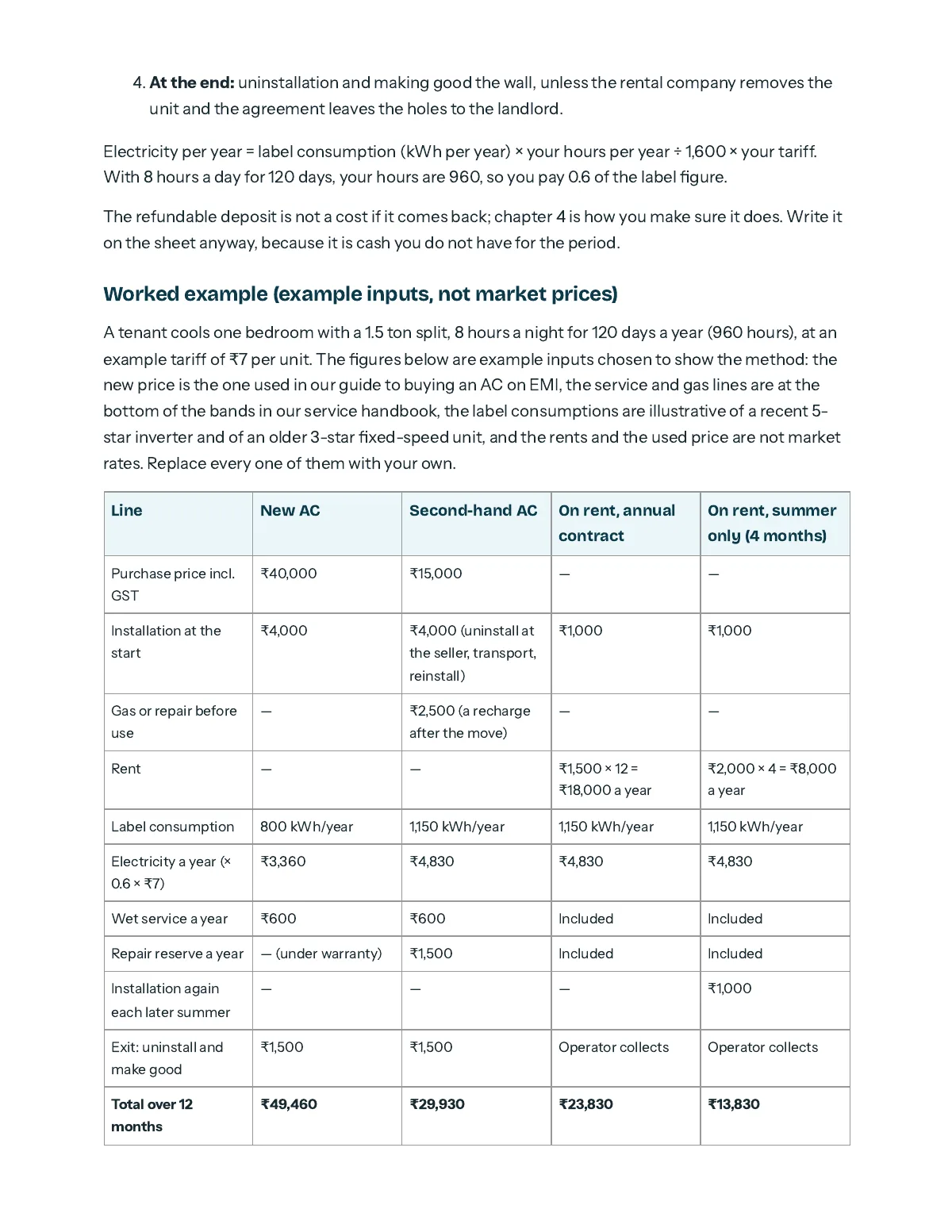
Electricity per year = label consumption (kWh per year) × your hours per year ÷ 1,600 × your tariff. With 8 hours a day for 120 days, your hours are 960, so you pay 0.6 of the label figure.
The refundable deposit is not a cost if it comes back; chapter 4 is how you make sure it does. Write it on the sheet anyway, because it is cash you do not have for the period.
Worked example (example inputs, not market prices)
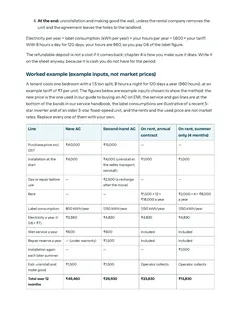
A tenant cools one bedroom with a 1.5 ton split, 8 hours a night for 120 days a year (960 hours), at an example tariff of ₹7 per unit. The figures below are example inputs chosen to show the method: the new price is the one used in our guide to buying an AC on EMI, the service and gas lines are at the bottom of the bands in our service handbook, the label consumptions are illustrative of a recent 5-star inverter and of an older 3-star fixed-speed unit, and the rents and the used price are not market rates. Replace every one of them with your own.
| Line | New AC | Second-hand AC | On rent, annual contract | On rent, summer only (4 months) |
|---|---|---|---|---|
| Purchase price incl. GST | ₹40,000 | ₹15,000 | — | — |
| Installation at the start | ₹4,000 | ₹4,000 (uninstall at the seller, transport, reinstall) | ₹1,000 | ₹1,000 |
| Gas or repair before use | — | ₹2,500 (a recharge after the move) | — | — |
| Rent | — | — | ₹1,500 × 12 = ₹18,000 a year | ₹2,000 × 4 = ₹8,000 a year |
| Label consumption | 800 kWh/year | 1,150 kWh/year | 1,150 kWh/year | 1,150 kWh/year |
| Electricity a year (× 0.6 × ₹7) | ₹3,360 | ₹4,830 | ₹4,830 | ₹4,830 |
| Wet service a year | ₹600 | ₹600 | Included | Included |
| Repair reserve a year | — (under warranty) | ₹1,500 | Included | Included |
| Installation again each later summer | — | — | — | ₹1,000 |
| Exit: uninstall and make good | ₹1,500 | ₹1,500 | Operator collects | Operator collects |
| Total over 12 months | ₹49,460 | ₹29,930 | ₹23,830 | ₹13,830 |
| Total over 36 months | ₹57,380 | ₹43,790 | ₹69,490 | ₹41,490 |
| What you hold at the end | A machine 3 years into a life of about a decade | An older machine, no warranty | Nothing; deposit back | Nothing; deposit back |
How the totals are built, so you can check them. New, 12 months: 40,000 + 4,000 + 3,360 + 600 + 1,500 = ₹49,460; 36 months: 44,000 + 3 × (3,360 + 600) + 1,500 = ₹57,380. Second-hand, 12 months: 15,000 + 4,000 + 2,500 + 4,830 + 600 + 1,500 + 1,500 = ₹29,930; 36 months: 21,500 + 3 × (4,830 + 600 + 1,500) + 1,500 = ₹43,790. Annual rent, 12 months: 1,000 + 18,000 + 4,830 = ₹23,830; 36 months: 1,000 + 3 × 22,830 = ₹69,490. Summer-only rent, 12 months: 1,000 + 8,000 + 4,830 = ₹13,830; 36 months: 1,000 + 2 × 1,000 + 3 × 12,830 = ₹41,490.
What the example shows, and what it does not:
- Over one summer, renting for the summer only is the smallest outflow, and an annual rental is still well below a purchase. A short, certain stay is what renting is for.
- Over three summers, an annual rental is the most expensive option: twelve months of rent a year for four months of cooling. A summer-only rental and a second-hand unit end up close, and both cost more each year in electricity than the new inverter.
- The new machine costs the most cash and leaves you the only asset: about seven summers of expected life still in it. If you will keep it after you leave this flat, part of its price belongs to your next home, not to this one.
- The electricity gap repeats every year: ₹1,470 a summer in the example (4,830 − 3,360), more if you run the AC longer or your slab is higher. Over ten summers it comes close to the whole price of the used machine in the example.
- Summer-only rentals depend on availability. In April and May, rental fleets and technicians run short; a contract signed in March at the March rate is not the same as one sought in May.
The cost comparison sheet (fill in, or use the spreadsheet)
| Line | Option A: ________ | Option B: ________ | Option C: ________ |
|---|---|---|---|
| Purchase price incl. GST (₹) | |||
| Installation at the start (₹) | |||
| Gas or repair before use (₹) | |||
| Monthly rent (₹) and months rented a year | |||
| Label consumption (kWh/year) and model number | |||
| Your hours a year ÷ 1,600 | |||
| Your tariff (₹ per unit) | |||
| Electricity a year (₹) | |||
| Service a year (₹) | |||
| Repair reserve a year (₹) | |||
| Installation again each later season (₹) | |||
| Exit cost (₹) | |||
| Refundable deposit (₹, not a cost if returned) | |||
| Total over 12 months (₹) | |||
| Total over 36 months (₹) |
Three cases where the arithmetic is not the answer
- You cannot drill. If the owner or the society will not allow a core hole, a split is off the table whatever it costs; a window unit in an existing opening, a rental company that takes responsibility for the fitting, or a portable unit are the options left. In dry inland heat, an evaporative air cooler needs no hole at all; whether it suits your city's humidity is the subject of our air cooler versus AC comparison.
- The landlord offers to fit one. An AC the owner buys and installs is his asset and, in a fair agreement, his repair. A modest rent increase for an owner-fitted inverter AC can beat every option in the table above: ask for it, and write the division of costs in the agreement (chapter 3).
- The wiring is not there. Older flats often lack a dedicated point of the right rating in the bedroom. Adding one is work on the owner's installation and his decision; running a split from a light circuit or an extension board is not an option at any price.
Checkout by Stripe
Card, Apple Pay or Google Pay on Stripe’s secure page. Your card details never pass through our servers.
Instant access
Your guide opens right after payment, ready to save as a PDF. Receipt by email; “Find my purchases” resends the link.
VAT included, paid once
The price shown is the total. No subscription, nothing charged later.
Sources you can check
6 official sources cited in this guide. We install nothing and sell no equipment. Terms of sale.
Frequently asked questions
How do I receive the guide?
Right after payment you are taken to your guide page, with the spreadsheet to download. Bookmark it: the link stays valid and always shows the latest version. To keep a PDF, save it from your browser (Ctrl+P or Cmd+P, then "Save as PDF"): the layout is made for printing. Stripe emails you the receipt, and "Find my purchases" at the bottom of every page sends the link again.
Is VAT included? Is it a subscription?
€19 is the total you pay, VAT included, once. There is no subscription and nothing is charged later. Your card details go to Stripe and never reach us.
Why is the price in euros?
The kit is sold by a French company through Stripe and charged in euros: the price shown is the total, paid once. Your bank converts it to rupees at its own rate and may add a foreign-transaction fee. Your card must be enabled for international online payments.
I already have the service handbook or the installation kit. Is this the same?
No. The service handbook starts after the purchase (faults, gas, AMC, shifting) and has one chapter on who pays in a rented flat. The installation kit is the fitting itself: positions, copper, drain, noise. This kit is the decision and the paperwork of a rented flat: new, used or rented over 12 and 36 months, the agreement, the deposit, the rental contract and the used-AC inspection.
Does it tell me what rent or used price is fair in my city?
No, and nobody can honestly do it from outside your city: rental rents and used prices are set locally and change with the season. The kit gives you the method and a spreadsheet to compare the quotes you actually receive, with your own tariff, and tells you what each price must absorb.
Is it useful for a landlord?
Yes. The division of costs, the AC schedule, the condition record and the deposit rules are written for both sides: a landlord who fits an AC, or allows a tenant to, settles the same questions once in the agreement instead of every summer.
What is the guarantee?
The guide is guaranteed as described: if it does not open or contains an error, we fix it, and if we cannot, we refund you in full (refund policy in the terms of sale). Write to admin@tech-bharat.com. A duplicate payment is always refunded.
Free guides on the same topic
- An AC in a rented flat: who pays, who drills, who keeps it
- Renting an AC in India: what a summer on rent really costs
- Buying a second-hand AC in India: what to check before you pay
- Buying an AC on EMI: what « no cost » actually costs
All printable guides and packs
€19 is the total you pay, VAT included: nothing is added at checkout. Payment by Stripe; your statement shows “CLAUDE AC”. See our terms of sale, which include our refund policy. Access is immediate after payment. Claude AC is an information publisher; the guide is not legal, engineering or financial advice.