The AC & Heat Pump Owner's Handbook: Maintenance and Troubleshooting (2026)
A 10-chapter handbook you read online or print, with a maintenance log spreadsheet, for US homeowners with a central AC, a heat pump or a ductless mini-split: keep it running, read the warning signs and know when to call.
- 10chapters
- 20worksheets and tables
- 21checklist items
- 11official sources cited
Checked before every release
- 54automated testsrun at every release: prices, links, pages and data checked before publication.
- 11primary sourcesevery rule and number linked to the official text, for you to open.
- October 22, 2026editionrules and numbers checked on this date, updated when a text changes.
Built from the texts and data of EPA, ENERGY STAR, U.S. Department of Energy, Code of Federal Regulations, FTC, ACCA.
Most air conditioners and heat pumps do not die suddenly. They lose airflow to a dirty filter, drown their drain line in algae, bake a weak capacitor through two summers or leak refrigerant for a season before anyone notices. Each failure gives warning signs, and most can be read by the owner with a flashlight, a thermometer and twenty minutes.
Every rule is quoted with its official source (ENERGY STAR, the Department of Energy, the EPA, the International Residential Code, the FTC) so you can check it. We do not repair, install or sell equipment and take no commission from contractors or maintenance plans: the handbook is on your side.
$29
Get the guide, $29Read chapter 1 free- 10 chapters (about 5,800 words): your system card, the calendar and filters, spring start-up, the professional tune-up, troubleshooting by symptom, mini-splits, refrigerant leaks, storms and winter, settings, humidity and calling for service, warranties and records
- 20 worksheets and reference tables, including a symptom guide for noises and smells, a tune-up readings sheet and a leak decision sheet
- One spreadsheet (CSV: Excel, Numbers, Google Sheets): the maintenance and filter log
Instant access: right after payment your guide opens in your browser; print it or save it as a PDF. $29, paid once, no subscription.
As described, or refunded in full · written into our terms of sale
For $60 more: US Homeowner AC Library 2026, 5 guides, $17.80 per guide.
Secure checkout by Stripe (card, Apple Pay, Google Pay), one-time payment with no subscription, instant access. Refund policy
What you get
- Your system card: identify the system, decode the nameplates (age, refrigerant, capacity) and draw the safety line between owner tasks and professional work.
- The calendar and the filter: what to do each month and season, MERV explained, and a filter log.
- Spring start-up step by step: outdoor unit, condensate drain, float switch test and the first-run readings that become your baseline.
- The tune-up: what ENERGY STAR and the ACCA standard expect, the readings to ask for, red flags and a maintenance-plan comparison.
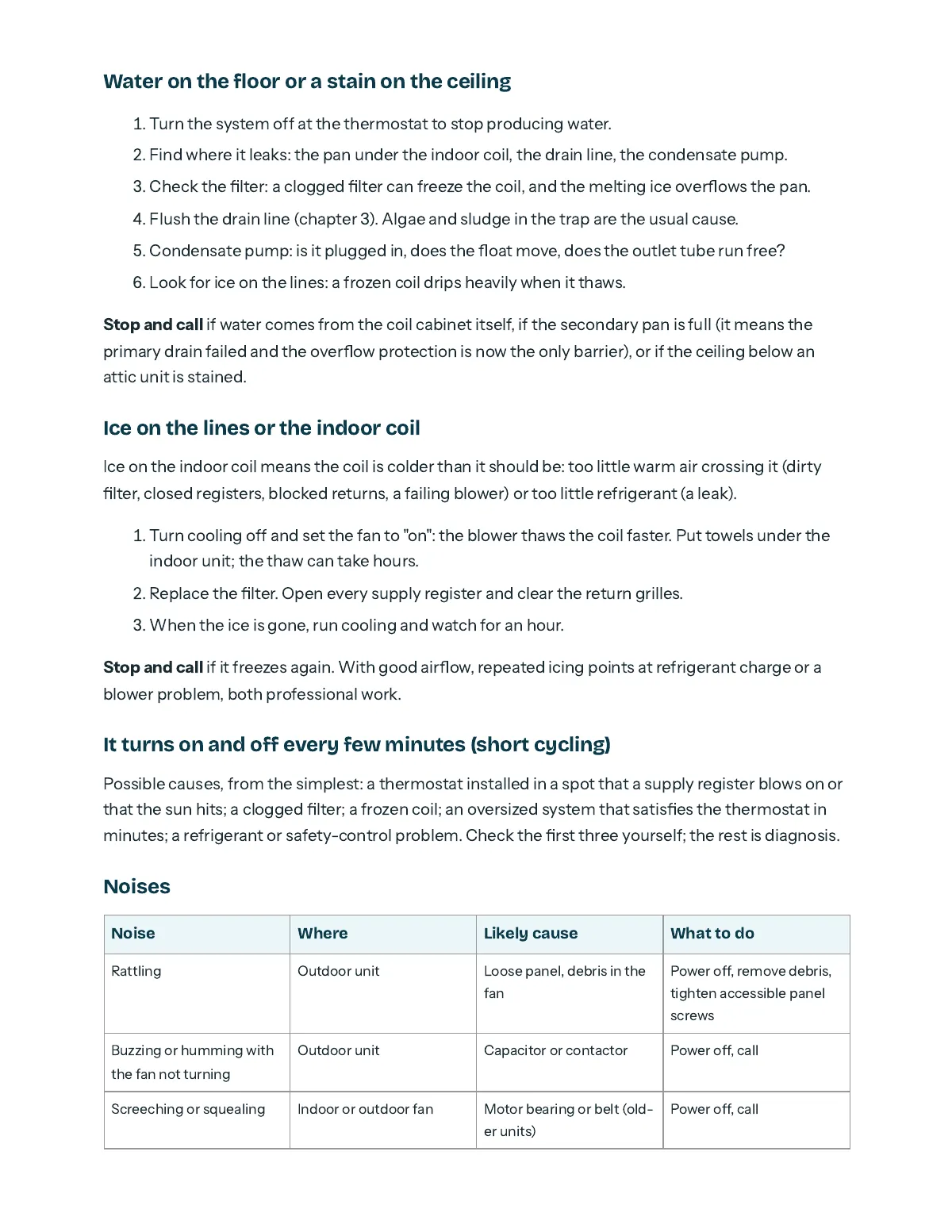
- Troubleshooting by symptom: no start, warm air, water on the floor, ice, short cycling, noises, smells, breakers, bills and heat pumps in winter, each with a clear "stop and call" line.
- Refrigerant leaks: the EPA rules in 2026, the questions to ask before paying for a recharge and a repair-or-replace sheet.
- Settings, humidity and service calls: thermostat settings that protect the system, the EPA humidity range, what to write down before calling and how to handle the visit.
- Storms, smoke and winter, then warranties (Magnuson-Moss), insurance in one paragraph and the maintenance log.
Free guides, this guide or the library
The free articles answer one question at a time. The guide puts it all in order and gives you the tools to act.
Free guides
$0
59 free articles
- ✓The rules explained, official sources cited
- —The decisions in order, from diagnosis to action
- —20 worksheets and tables to fill in
- —A spreadsheet ready to fill in
- —Print it or keep it as a PDF
- —All 5 guides for US homeowners in one purchase
Maintenance handbook
$29
paid once
- ✓The rules explained, official sources cited
- ✓The decisions in order, from diagnosis to action
- ✓20 worksheets and tables to fill in
- ✓A spreadsheet ready to fill in
- ✓Print it or keep it as a PDF
- —All 5 guides for US homeowners in one purchase
US Homeowner AC Library 2026
$89
5 guides, $145 bought one by one (you save $56)
- ✓The rules explained, official sources cited
- ✓The decisions in order, from diagnosis to action
- ✓20 worksheets and tables to fill in
- ✓A spreadsheet ready to fill in
- ✓Print it or keep it as a PDF
- ✓All 5 guides for US homeowners in one purchase
As described, or refunded in full
In pictures
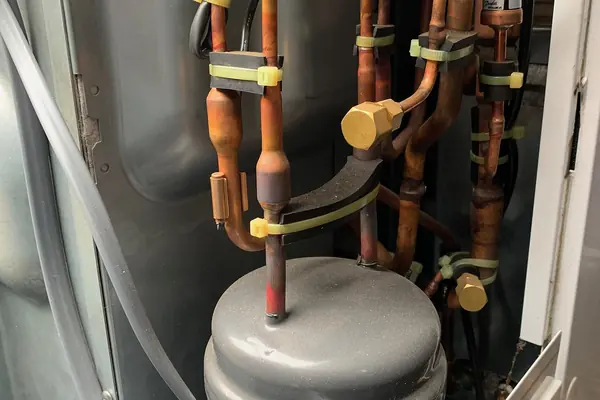



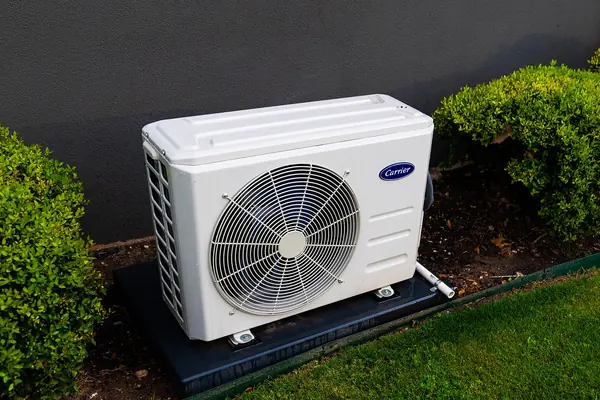

Illustrative photos, published by their authors under free licences.
Who it is for
- US homeowners with a central air conditioner, a heat pump or a ductless mini-split who want it to last, cost less to run and fail less often
- Anyone facing a symptom right now (water on the floor, ice on the lines, warm air, a breaker that trips) who wants to know what is safe to check before paying for a visit
- Owners who pay for a maintenance plan or a tune-up and want to know what should actually be done, and what to refuse
Contents
- Know your system before anything goes wrong free below
- The maintenance calendar and the filter
- Spring start-up, step by step
- The professional tune-up: what it should include
- Troubleshooting, symptom by symptom
- Ductless mini-splits
- Refrigerant leaks and recharges: what is true
- Storms, outages, smoke and winter
- Settings, humidity and calling for service
- Warranties, records and the next decision
In the paid chapters: 21 checkpoints to tick, and 20 worksheets or tables across the guide, each based on the rule or data it cites.
Introduction
Most air conditioners and heat pumps do not die suddenly. They lose airflow to a dirty filter, drown their drain line in algae, bake a weak capacitor through two summers or leak refrigerant for a season before anyone notices. Each of those failures gives warning signs, and most of the warnings can be read by the owner with a flashlight, a thermometer and twenty minutes. This handbook is the owner's side of the job: what to look at, when, what it means, what is safe to do yourself and what must go to a professional.
How to use it: fill in the system card in chapter 1 once, today, while nothing is wrong. Then follow the calendar in chapter 2. When something goes wrong, go straight to chapter 5 and find the symptom; each one ends with a clear line between what you can check and when to stop and call. Print it (Ctrl+P or Cmd+P, then "Save as PDF", or print on paper) and keep it near the thermostat or the air handler. The maintenance log is also on your access page as a spreadsheet.
The guidance is drawn from official sources, named in each chapter: the ENERGY STAR maintenance checklist and duct guidance, the U.S. Department of Energy's Energy Saver pages, the EPA's Section 608 refrigerant rules and its Technology Transitions program, the International Residential Code for condensate overflow protection, the FTC's guide to federal warranty law and the ACCA quality maintenance standard. Where the handbook gives a rule of thumb rather than a rule, it says so.
Chapter 1: Know your system before anything goes wrong
Ten minutes spent identifying your equipment pays back the first time you call for service: you will describe the problem precisely, recognize a wrong part on a quote and know whether your warranty still runs.
Which system do you have?
| What you see | System | Where the cooling happens | Where the heat comes from in winter |
|---|---|---|---|
| A metal box outside with a fan on top, and an indoor furnace with a coil on top of it | Split central air conditioner with a furnace | Indoor coil on the furnace | The furnace (gas, oil or electric) |
| A box outside, an indoor air handler (no burner), and a thermostat with an "emergency heat" or "aux" setting | Split heat pump | Indoor coil in the air handler | The heat pump, with electric backup strips in the air handler |
| A box outside, a heat pump, and a gas furnace indoors | Dual-fuel system | Indoor coil on the furnace | The heat pump in mild weather, the furnace below a set temperature |
| A box outside, one or more wall, ceiling or floor heads indoors, no ducts | Ductless mini-split (single or multi-zone) | Each indoor head | The same heads in heat mode |
| One single box outside (or on the roof) connected to the ducts | Packaged unit | Inside the packaged unit | Inside the packaged unit (gas or heat pump) |
Read the nameplates
Every outdoor unit, air handler and furnace carries a nameplate, usually on a side panel. Take a photo of each, then copy the essentials:
| Item | Outdoor unit | Indoor unit (air handler, coil or furnace) |
|---|---|---|
| Brand | ||
| Model number | ||
| Serial number | ||
| Manufacture date (on the plate, or decoded from the serial number using the manufacturer's guide) | ||
| Refrigerant type (R-22, R-410A, R-454B, R-32) | ||
| Factory charge (lb or oz) | ||
| Nominal capacity (tons, or BTU/h from the model number) | ||
| Minimum circuit ampacity and maximum fuse or breaker size | ||
| Capacitor rating (µF), if visible on the label of a spare or the wiring diagram |
The refrigerant line matters more than ever in 2026: it tells you whether a future leak repair will use R-22 (no longer produced for this use), R-410A (being phased down) or one of the newer A2L refrigerants (chapter 7).
Your system card (fill in once)
| Item | Your answer |
|---|---|
| Installing contractor, phone, date installed | |
| Warranty registered? Confirmation number, parts term, labor term | |
| Filter location(s) and exact size (length × width × depth, printed on the filter frame) | |
| Filter type and MERV rating you use | |
| Thermostat model; batteries (yes or no) | |
| Where the condensate drain leaves the house (pipe outside, floor drain, pump) | |
| Condensate pump or float switch present? Where? | |
| Outdoor disconnect location (the box on the wall near the outdoor unit) | |
| Breakers for the outdoor unit and the indoor unit (panel labels) | |
| Supply registers and return grilles per room (count) | |
| Date of the last professional maintenance |
The safety line
| You can do it | Never, call a professional |
|---|---|
| Change or wash filters | Open the refrigerant circuit, add or remove refrigerant |
| Clear debris and vegetation around the outdoor unit, power off | Touch capacitors, contactors or wiring inside the units, even with the power off: a capacitor can hold a charge |
| Rinse the outdoor coil gently with a garden hose, power off at the disconnect | Use a pressure washer on any coil |
| Clear the condensate line opening and flush it with water | Remove the furnace burner or heat exchanger covers |
| Replace thermostat batteries, check settings | Bypass a float switch, a high-limit switch or any safety device |
| Reset a breaker once | Reset a breaker that trips again |
| Read nameplates and log temperatures | Straighten fins with anything other than a fin comb, if the manufacturer allows owners to do it at all |
Also in the US Homeowner AC Library 2026: 5 guides for US homeowners in one purchase, $89.
Checkout by Stripe
Card, Apple Pay or Google Pay on Stripe’s secure page. Your card details never pass through our servers.
Instant access
Your guide opens right after payment, ready to save as a PDF. Receipt by email; “Find my purchases” resends the link.
One price, paid once
The price shown is the total, in US dollars. No subscription, nothing charged later.
Sources you can check
11 official sources cited in this guide. We install nothing and sell no equipment. Terms of sale.
Frequently asked questions
How do I receive the guide?
Right after payment you are taken to your guide page, with the spreadsheet to download. Bookmark it: the link stays valid and always shows the latest version. To keep a PDF, save it from your browser (Ctrl+P or Cmd+P, then "Save as PDF"): the layout is made for printing. Stripe emails you the receipt, and "Find my purchases" at the bottom of every page sends the link again.
Is it a subscription? Is anything added at checkout?
$29 is the total you pay, once. There is no subscription and nothing is charged later. Your card details go to Stripe and never reach us.
Will this teach me to repair my system?
It teaches you the checks that are safe for an owner and when to stop. It never asks you to open the refrigerant circuit or work on live electrical parts: capacitors, contactors and refrigerant are professional work, and the handbook tells you exactly what to ask the technician.
Does it cover heat pumps and mini-splits?
Yes: split central air conditioners with a furnace, heat pumps (including defrost, auxiliary and emergency heat), dual-fuel systems, packaged units and ductless mini-splits, with a chapter dedicated to mini-splits.
What is the guarantee?
The guide is guaranteed as described: if it does not open or contains an error, we fix it, and if we cannot, we refund you in full (refund policy in the terms of sale). Write to admin@tech-bharat.com. A duplicate payment is always refunded.
Free guides on the same topic
- AC maintenance: the yearly rhythm that keeps a system honest
- Water on the floor: the condensate drain, from clog to float switch
- AC not cooling: the diagnostic order that saves a service call
- Ice on the coil: why an air conditioner freezes up
- Cleaning a mini-split: the blower wheel, the pan, and the smell that keeps coming back
All printable guides and packs
$29 is the total you pay, charged in US dollars: nothing is added at checkout. Payment by Stripe; your statement shows “CLAUDE AC”. See our terms of sale, which include our refund policy. Access is immediate after payment. Claude AC is an information publisher; the guide is not legal, engineering or financial advice.