New-Build Home HVAC Checklist: Pre-Closing and 11-Month Warranty Kit (2026)
An 11-chapter kit you read online or print, with a warranty register and defect log spreadsheet, for buyers of a newly built home in the US: get the heating and cooling system checked, registered and fixed while the builder still owes it.
- 11chapters
- 14worksheets and tables
- 97checklist items
- 12official sources cited
Checked before every release
- 54automated testsrun at every release: prices, links, pages and data checked before publication.
- 12primary sourcesevery rule and number linked to the official text, for you to open.
- October 30, 2026editionrules and numbers checked on this date, updated when a text changes.
Built from the texts and data of ENERGY STAR, EPA, Code of Federal Regulations.
A new house comes with three protections on its heating and cooling system: the builder’s, the HVAC subcontractor’s through the builder, and the manufacturer’s. Each has its own clock, most start at closing, and each needs something from you at a precise moment: a document before the drywall, a test before you sign, a registration within weeks, a written list before the first anniversary. This kit puts those moments in order.
Every rule is quoted from its source (the International Residential Code, the ENERGY STAR HVAC Design Report, Commissioning Checklist and Rater Field Checklist, HUD form 92544, the New Jersey, Minnesota and Virginia new-home warranty rules, the DOE efficiency standards, the manufacturers’ published registration terms) and the one study cited has its DOI. We do not build, inspect, install or sell anything and take no commission: the kit is on your side.
€29
Get the guide, €29Read chapter 1 free- 11 chapters (about 10,000 words): who owes what, before drywall, certified homes, permit and equipment record, the walkthrough, registration, months 1 to 10, the 11-month inspection, when the builder says no, the letters, your file
- 14 worksheets and reference tables, including the ENERGY STAR sizing limits, a room-by-room walkthrough table and the 11-month checklist
- One spreadsheet (CSV: Excel, Numbers, Google Sheets): warranty register, defect log and temperature log
Instant access: right after payment your guide opens in your browser; print it or save it as a PDF. €29, paid once, no subscription.
As described, or refunded in full · written into our terms of sale
Secure checkout by Stripe (card, Apple Pay, Google Pay), one-time payment with no subscription, instant access. Refund policy
What you get
- Who owes what, and when: builder, subcontractor and manufacturer, the 1-2-10 structure, state rules in New Jersey, Minnesota and Virginia, HUD form 92544, and the calendar of the first year.
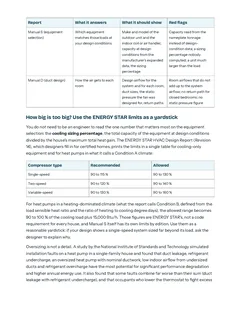
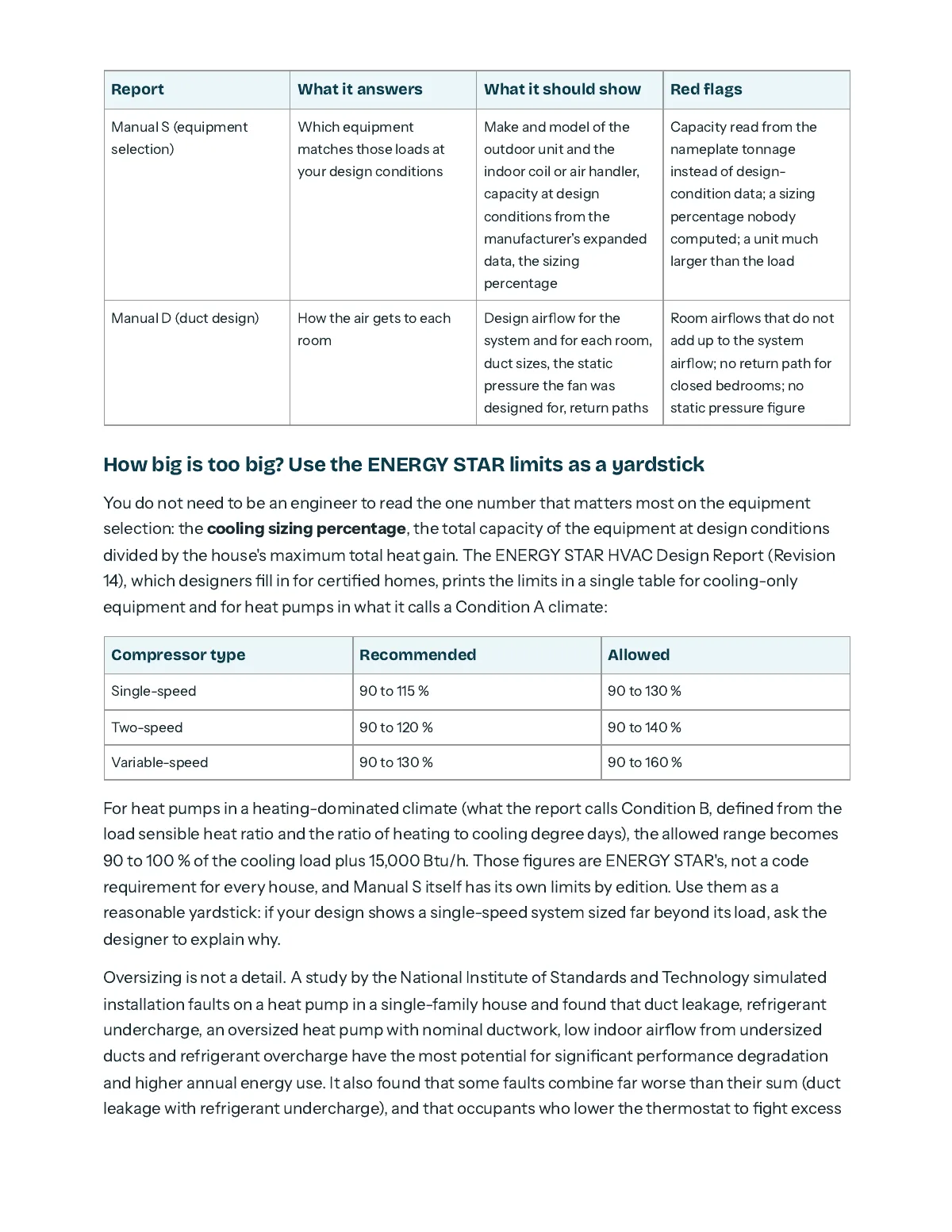
- Before drywall: the Manual J, S and D reports in plain words, the ENERGY STAR cooling sizing limits as a yardstick, and the pre-drywall look at ducts, returns, line set and drains.
- Certified homes: Track A and Track B, what the Commissioning Checklist records (refrigerant charge, airflow within 15 % of design), and the duct leakage and bedroom pressure limits of the Rater Field Checklist.
- Permit and equipment record: final inspection, nameplates, the AHRI match, the federal SEER2 floor by region and the refrigerant on the nameplate.
- The pre-closing walkthrough: the system checklist, the temperature split, the room-by-room table, what to do when the season prevents a test, and how to write the punch list.
- Registration at closing: what Lennox, Trane, Rheem and Carrier publish about new construction, who registered what in whose name, and the first-week checklist.
- The 11-month warranty inspection: when to book it, who can do it, the checklist, what a performance standard looks like, and sending the list before the anniversary.
- When the builder says no: the five usual answers and your response, the order of escalation, state program deadlines, and six letters from the design request to the final notice.
Free guides or the printable guide
The free articles answer one question at a time. The guide puts it all in order and gives you the tools to act.
Free guides
€0
59 free articles
- ✓The rules explained, official sources cited
- —The decisions in order, from diagnosis to action
- —14 worksheets and tables to fill in
- —A spreadsheet ready to fill in
- —Print it or keep it as a PDF
New-build HVAC kit
€29
VAT included, paid once
- ✓The rules explained, official sources cited
- ✓The decisions in order, from diagnosis to action
- ✓14 worksheets and tables to fill in
- ✓A spreadsheet ready to fill in
- ✓Print it or keep it as a PDF
As described, or refunded in full
Who it is for
- Buyers of a newly built house in the US, from contract signature to the end of the builder's first year, who want the heating and cooling system checked while the builder still owes it
- New-build owners already in the house, with rooms that never cool, water near the air handler or a builder who keeps saying it is normal, and a warranty clock that is running
- Buyers of an ENERGY STAR certified or HERS-rated new home who want the HVAC reports that certification produced, and to know what they mean
Contents
- The first year on one page: who owes what, and when free below
- Before drywall: the design reports and what to look at
- ENERGY STAR and other certified homes: the HVAC paperwork
- Permit, final inspection and the equipment record
- The pre-closing walkthrough, room by room
- Registration: the manufacturer warranty starts at closing (or earlier)
- Months 1 to 10: living with it and keeping the evidence
- The 11-month warranty inspection
- When the builder says no
- Six letter templates
- Your defect log and warranty file
In the paid chapters: 92 checkpoints to tick, and 14 worksheets or tables across the guide, each based on the rule or data it cites.
Introduction
A new house comes with more heating and cooling protection than most buyers ever use. The builder answers for the design and the installation, usually for one or two years. The manufacturer answers for the equipment, often for ten years if it is registered in time. Code inspections, and in a certified home a third-party rater, have checked parts of the work. And yet the same complaints come back every summer: the bonus room over the garage that never cools, a bedroom that runs hot with the door closed, water in the attic pan, an outdoor unit nobody registered, and a builder who answers in month thirteen that the warranty has ended.
None of that is bad luck. It is a calendar problem. Each protection has its own clock, most of them start at closing, and each needs something from you at a precise moment: a document requested before the drywall goes up, a test run before you sign, a registration done within weeks, a written list sent before the first anniversary. This kit puts those moments in order and gives you the checklist, the letter or the log for each one.
How to use it: read chapter 1 now, whatever stage you are at. If the house is still being built, do chapters 2 to 4 before the drywall stage and before closing. In the last weeks before closing, chapter 5 is the walkthrough and chapter 6 the registrations. Once you live in the house, chapter 7 tells you what to log, chapter 8 is the 11-month inspection, and chapter 9 is for a builder who says no. The six letters are in chapter 10, and the defect log and warranty file in chapter 11 (also on your access page as a spreadsheet). Print it (Ctrl+P or Cmd+P, then "Save as PDF", or on paper) and keep it with your closing documents.
The rules quoted come from named sources, read in October 2026: the International Residential Code sections on equipment sizing, duct design and condensate disposal; the ENERGY STAR Single-Family New Homes HVAC Design Report, HVAC Commissioning Checklist and Rater Field Checklist (Revision 14); HUD's Warranty of Completion of Construction for FHA-insured new homes; the New Jersey New Home Warranty program, the Minnesota statutory home warranty and the Virginia implied warranty on new dwellings, given as examples of state rules; the Department of Energy's efficiency standards; the published registration terms of several equipment manufacturers; and one study, by the National Institute of Standards and Technology, with its DOI.
Chapter 1: The first year on one page: who owes what, and when
A new house has three parties who answer for the heating and cooling system, and each one answers for something different. Getting the right one on the phone is half of every claim.
Who answers for what
| Who | What they answer for | Usual term | Where it is written |
|---|---|---|---|
| The builder | The design and installation of the system as part of the house: sizing, ducts, returns, drains, line set, controls, and the HVAC subcontractor's work | Often one year for workmanship and two years for mechanical systems; check yours | Your builder's written warranty, your purchase contract, state law where it exists |
| The HVAC subcontractor | Its own work, but it was hired by the builder: you normally go through the builder | Whatever its contract with the builder says | Usually not a document you receive |
| The equipment manufacturer | A part that fails because of a defect in materials or workmanship | Often five years of parts, ten if registered in time; labor rarely included | The warranty certificate of each unit, and the manufacturer's registration terms |
| A home warranty company (only if someone bought a contract) | Breakdowns covered by its contract, up to its limits | One year, renewable | The service contract, which is not a warranty in the legal sense |
The 1-2-10 structure, and why it is only a starting point
Many builder warranties follow a "1-2-10" pattern: one year for defects in workmanship and materials, two years for the plumbing, electrical, heating and cooling systems, and ten years for major structural defects. It is a common structure, not a federal rule. Your own document may cover the HVAC system for only one year, may exclude items you assumed were included, and almost always sets a procedure for claims (in writing, to a named department) and sometimes a mandatory arbitration clause.
Some states write this structure into law. Three examples show how different the rules can be:
- New Jersey: under the New Home Warranty program, the state's homeowner booklet says that in the first year the warranty covers defective systems, workmanship and materials, and that up to two years it covers the mechanical, electrical and plumbing systems and major structural defects, with ten years for major structural defects. It also sets performance standards for heating and cooling (chapter 8) and strict claim deadlines (chapter 9).
- Minnesota: the statute (Minnesota Statutes, section 327A.02) gives a one-year warranty against defects caused by faulty workmanship and defective materials, a two-year warranty against defects caused by faulty installation of plumbing, electrical, heating and cooling systems, and a ten-year warranty against major construction defects, in each case due to noncompliance with building standards. Section 327A.03 excludes loss or damage not reported to the builder in writing within six months after you discover it or should have discovered it.
- Virginia: Code of Virginia section 55.1-357 gives implied warranties on a new dwelling for one year from the transfer of record title or your taking possession, whichever comes first (five years for the foundation). A claim must be sent as a written notice by certified mail or commercial overnight delivery, and the builder then has a reasonable time, not more than six months, to cure the defect.
If the home was bought with an FHA-insured loan, HUD requires the builder and the buyer to sign a Warranty of Completion of Construction (form HUD-92544), a one-year builder warranty. HUD states that it starts on the date title is conveyed, the date construction is completed, or occupancy, whichever comes first.
The clocks start at closing, and some of them earlier
For you, almost everything starts on the closing date or the day you take possession. For the equipment, the clock may have started earlier: the outdoor unit may have been set on its pad and run months before you signed. Manufacturers deal with this differently (chapter 6), and the difference decides whether your ten years exist.
The calendar of a new-build year
| When | What happens | What you do | Chapter |
|---|---|---|---|
| Contract, before construction | Plans and options are fixed | Ask in writing for the HVAC design documents to be supplied | 2, 10 (letter 1) |
| Pre-drywall (frame stage) | Ducts, returns, line set and drains are visible for the last time | Pre-drywall look, photos of every run, rater's pre-drywall inspection if certified | 2, 3 |
| Two to four weeks before closing | Final inspection, certification, punch list | Request the permit, inspection and certification records | 3, 4, 10 (letter 2) |
| Final walkthrough | Your last look before you sign | Room-by-room HVAC walkthrough, written punch list | 5, 10 (letter 3) |
| Closing day | Most warranty clocks start | Note the date; photograph nameplates if not done | 1, 6 |
| First weeks after closing | Manufacturer registration windows run | Register every unit yourself; ask who registered what | 6, 10 (letter 4) |
| Months 1 to 10 | You discover how the house behaves in heat and cold | Keep the temperature and defect log; report in writing as you go | 7, 11 |
| Month 10 to 11 | Last weeks of the first-year coverage | 11-month inspection, written list to the builder before the anniversary | 8, 10 (letter 5) |
| Month 12 and after | First-year items may close; second-year mechanical coverage may run | Follow up on open items; plan the 23-month check if you have two years | 8, 9, 10 (letter 6) |
What to do this week
- Find your builder's written warranty and write down, for the heating and cooling system, the term (one year, two years), the claim procedure and the address or portal for claims.
- Write your closing date, or expected closing date, at the top of the defect log in chapter 11.
- Check whether your state has a statutory new-home warranty or a state program, and whether your loan is FHA-insured (form HUD-92544 in your closing papers).
- Ask whether the home is being certified (ENERGY STAR, a HERS rating, a utility program): if yes, chapter 3 lists the documents it produces.
- Put two dates in your calendar now: ten months after closing (book the 11-month inspection) and eleven months after closing (send the written list).
Checkout by Stripe
Card, Apple Pay or Google Pay on Stripe’s secure page. Your card details never pass through our servers.
Instant access
Your guide opens right after payment, ready to save as a PDF. Receipt by email; “Find my purchases” resends the link.
VAT included, paid once
The price shown is the total. No subscription, nothing charged later.
Sources you can check
12 official sources cited in this guide. We install nothing and sell no equipment. Terms of sale.
Frequently asked questions
How do I receive the guide?
Right after payment you are taken to your guide page, with the spreadsheet to download. Bookmark it: the link stays valid and always shows the latest version. To keep a PDF, save it from your browser (Ctrl+P or Cmd+P, then "Save as PDF"): the layout is made for printing. Stripe emails you the receipt, and "Find my purchases" at the bottom of every page sends the link again.
Is VAT included? Is it a subscription?
€29 is the total you pay, VAT included, once. There is no subscription and nothing is charged later. Your card details go to Stripe and never reach us.
Why is the price in euros?
The kit is sold by a French company through Stripe and charged in euros: the price shown is the total, paid once. Your bank converts it to dollars at its own rate and may add a foreign-transaction fee.
I already closed. Is it too late?
No. Chapters 6 to 11 are written for owners already in the house: registration, the temperature and defect log, the 11-month inspection, the letters and the escalation steps. If you are past the first anniversary, check whether your builder warranty or your state covers mechanical systems for two years.
I have the Warranty and Claims Workbook. Is this the same?
No. The workbook covers every warranty, home warranty and insurance claim on any house, with one chapter on new homes. This kit is only about a new build, from the drywall stage to the 11-month inspection, with the documents, checklists and letters that the workbook does not have.
Do you recommend an inspector or a builder?
No. We recommend no company and take no commission. The kit tells you what to ask any inspector for and what to check, so you can judge the report you get.
What is the guarantee?
The guide is guaranteed as described: if it does not open or contains an error, we fix it, and if we cannot, we refund you in full (refund policy in the terms of sale). Write to admin@tech-bharat.com. A duplicate payment is always refunded.
Free guides on the same topic
- HVAC permits: what a legal system replacement involves
- Reading the nameplate: your air conditioner’s size, age, refrigerant and circuit
- Reading an HVAC quote: how to choose a contractor without guessing
- New home HVAC warranty: what the builder covers, what the manufacturer covers, and the 11-month check
All printable guides and packs
€29 is the total you pay, VAT included: nothing is added at checkout. Payment by Stripe; your statement shows “CLAUDE AC”. See our terms of sale, which include our refund policy. Access is immediate after payment. Claude AC is an information publisher; the guide is not legal, engineering or financial advice.