The Room Air Conditioner Handbook: Window, Portable and Through-the-Wall Units (2026)
A 11-chapter handbook you read online or print, with a sizing and summer-cost spreadsheet, for US renters and owners cooling single rooms with a window, portable, through-the-wall or PTAC unit.
- 11chapters
- 17worksheets and tables
- 30checklist items
- 12official sources cited
Checked before every release
- 54automated testsrun at every release: prices, links, pages and data checked before publication.
- 12primary sourcesevery rule and number linked to the official text, for you to open.
- October 23, 2026editionrules and numbers checked on this date, updated when a text changes.
Built from the texts and data of ENERGY STAR, Code of Federal Regulations, FTC, U.S. Department of Energy, EPA.
The same 8,000 BTU unit can keep a bedroom comfortable all summer, or leak cold air around a badly sealed sash, trip the breaker every afternoon and hang over the street on nothing but a window frame. The difference rarely comes from the brand: it comes from the type, the size, the window, the circuit and the way it is run.
Every rule is quoted with its official source (ENERGY STAR, the Department of Energy’s 2026 efficiency standards, the FTC, the EIA, the electrical code, New York City, Phoenix and Montgomery County rules) so you can check it. We do not sell, install or recommend equipment or stores: the handbook is on your side.
$19
Get the guide, $19Read chapter 1 free- 11 chapters (about 7,700 words): the type, the size, the label, power and circuits, a safe window installation, sealing, water and noise, portables, wall units and PTACs, renters’ rules, running cost, upkeep and winter
- 17 worksheets and reference tables, including the ENERGY STAR sizing table with its corrections, a circuit check and two letters to the landlord
- One spreadsheet (CSV: Excel, Numbers, Google Sheets): BTU per room and the cost of a summer for two models
Instant access: right after payment your guide opens in your browser; print it or save it as a PDF. $19, paid once, no subscription.
As described, or refunded in full · written into our terms of sale
For $70 more: US Homeowner AC Library 2026, 5 guides, $17.80 per guide.
Secure checkout by Stripe (card, Apple Pay, Google Pay), one-time payment with no subscription, instant access. Refund policy
What you get
- The right type: window, U-shaped, casement, portable, through-the-wall, PTAC or mini-split, chosen from your window, your lease and your noise limit.
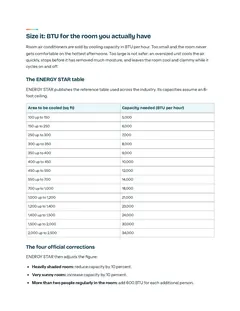
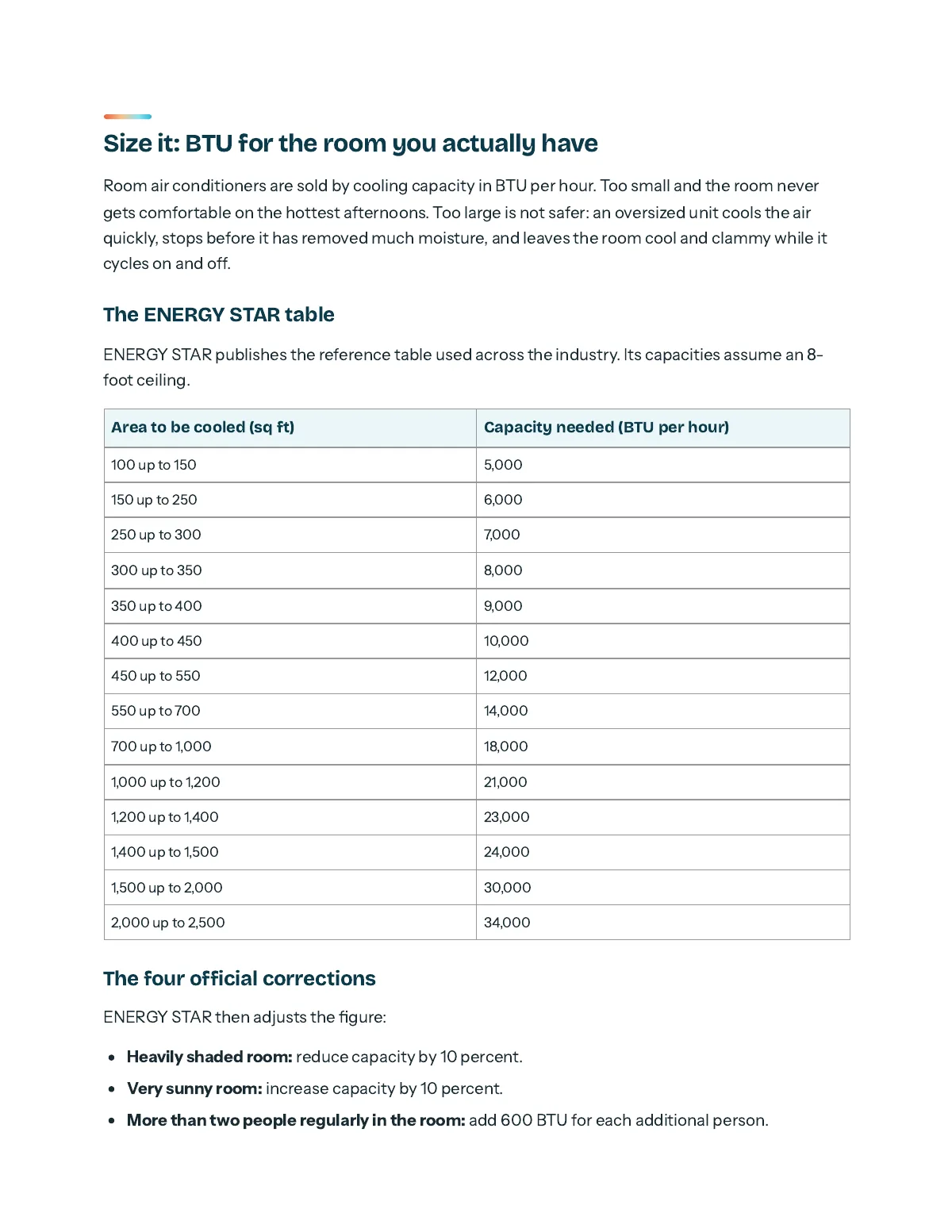
- The right size: the ENERGY STAR table, its four official corrections and three rooms worked out.
- The label decoded: CEER, SACC on portables, and the federal minimums for units made from May 26, 2026.
- Power without trips: plugs, the 80 % and 50 % circuit rules, the safety plug and the checklist.
- A safe window installation: support, sash lock, fire escapes, and the window-guard rule when children live in the home.
- Sealing, water and noise, and how to set up a portable so it works as well as it can.
- Renters’ rules: what the lease and local ordinances require, with two letters to the landlord.
- Your summer cost at your own rate (EIA prices by state), settings, upkeep, troubleshooting, winter and disposal.
Free guides, this guide or the library
The free articles answer one question at a time. The guide puts it all in order and gives you the tools to act.
Free guides
$0
59 free articles
- ✓The rules explained, official sources cited
- —The decisions in order, from diagnosis to action
- —17 worksheets and tables to fill in
- —A spreadsheet ready to fill in
- —Print it or keep it as a PDF
- —All 5 guides for US homeowners in one purchase
Room AC handbook
$19
paid once
- ✓The rules explained, official sources cited
- ✓The decisions in order, from diagnosis to action
- ✓17 worksheets and tables to fill in
- ✓A spreadsheet ready to fill in
- ✓Print it or keep it as a PDF
- —All 5 guides for US homeowners in one purchase
US Homeowner AC Library 2026
$89
5 guides, $145 bought one by one (you save $56)
- ✓The rules explained, official sources cited
- ✓The decisions in order, from diagnosis to action
- ✓17 worksheets and tables to fill in
- ✓A spreadsheet ready to fill in
- ✓Print it or keep it as a PDF
- ✓All 5 guides for US homeowners in one purchase
As described, or refunded in full
In pictures
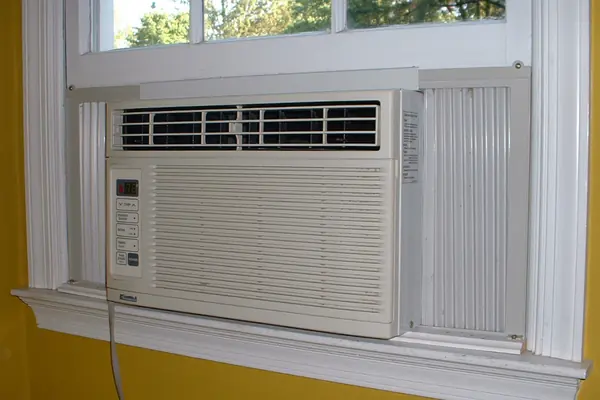

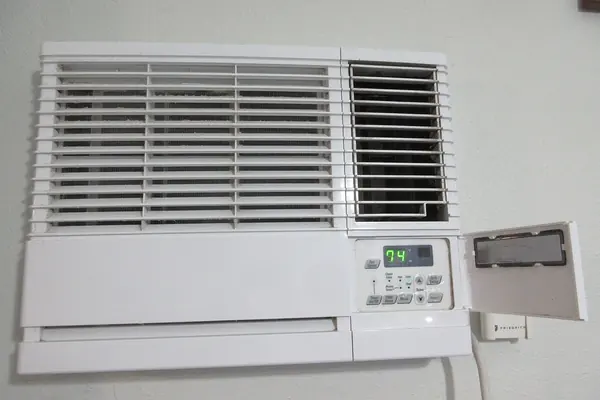

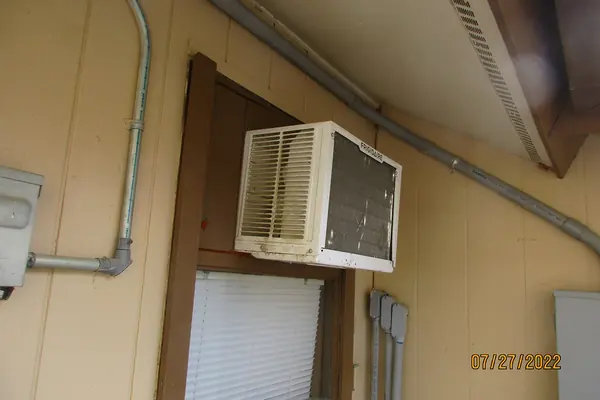

Illustrative photos, published by their authors under free licences.
Who it is for
- Renters and owners without central air who cool one room or a few rooms: apartments, bedrooms, home offices, garages turned into gyms, ADUs and additions
- Anyone about to buy a window, portable, through-the-wall or PTAC unit who wants the right type and size the first time, and an installation that is safe on an upper floor
- Owners of a unit that disappoints (warm room, water on the sill, breaker trips, rattles) who want to find out whether the machine, the size or the installation is to blame
Contents
- Choose the type that fits your room, your windows and your lease free below
- Size it: BTU for the room you actually have
- Read the label: CEER, SACC and the 2026 federal minimums
- Power: plugs, circuits and the cord
- Install a window unit safely
- Seal it, drain it, quiet it
- Portable units done right
- Through-the-wall units and PTACs
- Renters: the lease, the landlord and local cooling rules
- Running cost, settings and heat days
- Upkeep, troubleshooting, winter and end of life
In the paid chapters: 30 checkpoints to tick, and 17 worksheets or tables across the guide, each based on the rule or data it cites.
Introduction
A room air conditioner is the cooling most Americans choose themselves, carry home themselves and install themselves. That freedom is also the trap. The same 8,000 BTU unit can keep a bedroom comfortable all summer, or leak cold air around a badly sealed sash, trip the breaker every afternoon, drip on the neighbor's balcony and, on an upper floor, hang over the street on nothing but a window frame. The difference rarely comes from the brand. It comes from five decisions: the type of unit, its size, the window or wall it goes into, the circuit behind it and the way it is run.
This handbook walks you through those decisions in order. Chapter 1 matches the type of unit to your room, your windows and your lease. Chapter 2 sizes it with the ENERGY STAR table and the corrections that matter. Chapter 3 decodes the yellow EnergyGuide label, the CEER and the SACC figure that portables now carry, including the federal minimums that apply to units made from May 26, 2026. Chapters 4 to 8 cover the circuit, a safe window installation, sealing and drainage, portables and through-the-wall units. Chapter 9 is for renters. Chapters 10 and 11 cover the running cost with your own electricity rate, settings, upkeep, troubleshooting, winter and the end of the machine's life.
Print it (Ctrl+P or Cmd+P, then "Save as PDF", or print on paper): the worksheets are made to be filled in with a pencil and a tape measure. The sizing and running-cost calculator is also on your access page as a spreadsheet.
The rules quoted come from named official sources: ENERGY STAR's room air conditioner sizing guidance, the Department of Energy's efficiency standards for room and portable air conditioners (10 CFR part 430), the FTC's Energy Labeling Rule, the U.S. Energy Information Administration's electricity prices, the National Electrical Code as summarized in trade references, the EPA's refrigerant rules and, for local examples, the New York City Department of Buildings and Department of Health, the City of Phoenix and Montgomery County, Maryland. Where something is a rule of thumb rather than a rule, the handbook says so.
Chapter 1: Choose the type that fits your room, your windows and your lease
Before you look at a single price tag, three questions settle most of the choice: what kind of window or wall you have, whether you are allowed to put something in it, and whether the machine has to move from room to room.
The six options side by side
| Type | How it works | Best for | Main limits |
|---|---|---|---|
| Standard window unit | One box in a double-hung (up-and-down) window; the hot half sits outdoors | Most bedrooms and living rooms in rentals | Blocks part of the window; needs support outside or firm fastening; banned in some buildings |
| U-shaped or saddle window unit | Two halves joined by a channel; the window closes down into the U | Bedrooms where noise matters; the window can still close partly | Needs a double-hung window and enough sill depth; heavier to lift |
| Casement or slider unit | Tall, narrow chassis made for crank-out or sideways sliding windows | Rooms with casement or horizontal slider windows | Smaller choice of models; the window opening must be sealed with a rigid panel |
| Portable unit | Whole machine in the room; heat leaves through one or two hoses to a window kit | Rooms where no window unit is allowed or possible; moving between rooms | Least efficient per watt; takes floor space; the hose and window kit decide how well it works |
| Through-the-wall unit or PTAC | A chassis in a metal sleeve through the outside wall | Owners: additions, garages, condos, permanent single-room cooling | Needs a sleeve that matches the chassis; a new wall opening is construction work |
| Ductless mini-split | Outdoor unit plus one or more indoor heads, joined by refrigerant lines | Owners who want quiet, efficient, permanent cooling and often heating | Permit, electrical work and refrigerant connection; usually not a renter's choice |
The decision in five questions
- What kind of window is in the room? Double-hung: any window unit fits the type question. Horizontal slider: a slider unit or a portable. Casement (crank-out): a casement unit or a portable. Fixed glass only: a wall unit or a mini-split, or a portable vented through another window.
- Are you allowed to put a unit in the window? Read the lease and the building rules first (chapter 9). Some buildings ban window units on the street facade, some require professional installation, and in New York City a window that leads to a fire escape must never be blocked.
- Does the machine have to move? Only a portable moves easily. A window unit can move to another window of the same size, but it is a two-person job each time.
- How long will you stay? For one summer in a rental, a window or portable unit. For years in a home you own, compare a through-the-wall unit or a mini-split, which seal better and run quieter.
- How much noise can you accept? In a bedroom, a U-shaped window unit or a mini-split keeps the compressor outside the room. A portable keeps it beside your bed.
Window or portable: the honest comparison
A window unit hangs its hot side outdoors and seals the loop. A portable sits entirely in the room and exhausts heat through a hose; a single-hose model pushes room air outside and the same volume of warmer outdoor air leaks back in through every gap. Federal test rules now account for that: since the Department of Energy's portable air conditioner test procedure (appendix CC), portables are rated by a seasonally adjusted cooling capacity (SACC) that includes the effect of the hose and of infiltration, and since January 10, 2025, portables made for the US market have had to meet federal minimum efficiency standards measured that way. The result, seen on any label, is that a portable delivers noticeably less cooling per watt than a window unit of the same nominal size.
Choose the portable when you have to: casement or fixed windows, a building that bans window units, an upper floor where you cannot install a window unit safely, or a real need to move it. When you do, prefer a dual-hose model, keep the hose short and straight, and judge only by the SACC (chapter 7).
Your room card (fill in, one per room)
| Item | Room 1 | Room 2 | Room 3 |
|---|---|---|---|
| Room name and floor | |||
| Length × width (ft) and area (sq ft) | |||
| Ceiling height (ft) | |||
| Window type (double-hung, slider, casement, fixed) | |||
| Window opening: width between jambs (in) | |||
| Window opening: height when fully open (in) | |||
| Sill depth inside / outside (in) | |||
| Window leads to a fire escape? (yes / no) | |||
| Nearest outlet: type and distance (ft) | |||
| Lease or building rule on window units | |||
| Type chosen |
Also in the US Homeowner AC Library 2026: 5 guides for US homeowners in one purchase, $89.
Checkout by Stripe
Card, Apple Pay or Google Pay on Stripe’s secure page. Your card details never pass through our servers.
Instant access
Your guide opens right after payment, ready to save as a PDF. Receipt by email; “Find my purchases” resends the link.
One price, paid once
The price shown is the total, in US dollars. No subscription, nothing charged later.
Sources you can check
12 official sources cited in this guide. We install nothing and sell no equipment. Terms of sale.
Frequently asked questions
How do I receive the guide?
Right after payment you are taken to your guide page, with the spreadsheet to download. Bookmark it: the link stays valid and always shows the latest version. To keep a PDF, save it from your browser (Ctrl+P or Cmd+P, then "Save as PDF"): the layout is made for printing. Stripe emails you the receipt, and "Find my purchases" at the bottom of every page sends the link again.
Is it a subscription? Is anything added at checkout?
$19 is the total you pay, once. There is no subscription and nothing is charged later. Your card details go to Stripe and never reach us.
I rent. Can I use this?
Yes, it is written mainly for renters: chapter 9 covers the lease, permission letters and local cooling rules, and chapters 5 to 7 cover installations that leave the window as you found it.
Do you recommend a model?
No. We sell no equipment and take no commission. The handbook gives you the sizing table, the label figures and the checklists to compare the models you find.
What is the guarantee?
The guide is guaranteed as described: if it does not open or contains an error, we fix it, and if we cannot, we refund you in full (refund policy in the terms of sale). Write to admin@tech-bharat.com. A duplicate payment is always refunded.
Free guides on the same topic
- Window vs portable AC: the room-cooling showdown
- Installing a window air conditioner: brackets, seals and the right circuit
- Through-the-wall air conditioners and PTACs: the sleeve decides everything
- Air conditioning in a rental: what a landlord owes you, and what you can install
- BTU sizing guide: matching cooling power to real rooms
All printable guides and packs
$19 is the total you pay, charged in US dollars: nothing is added at checkout. Payment by Stripe; your statement shows “CLAUDE AC”. See our terms of sale, which include our refund policy. Access is immediate after payment. Claude AC is an information publisher; the guide is not legal, engineering or financial advice.