Multi-Unit AC Maintenance and F-Gas Leak-Check Kit for European Landlords and Small Businesses (2026)
A 9-chapter kit you read online or print, with two spreadsheets, for landlords, small businesses and managing agents in Europe who are responsible for several air conditioners or heat pumps and want one register, one calendar, the legal leak checks done on time and one maintenance contract that covers it all.
- 9chapters
- 18worksheets and tables
- 27checklist items
- 4official sources cited
Checked before every release
- 54automated testsrun at every release: prices, links, pages and data checked before publication.
- 4primary sourcesevery rule and number linked to the official text, for you to open.
- November 5, 2026editionrules and numbers checked on this date, updated when a text changes.
Built from the texts and data of GOV.UK, EUR-Lex, Légifrance, BOE.
Five, ten or thirty air conditioners spread over flats you let, a shop or an office are no longer appliances but equipment you operate. Some of them must be checked for leaks by law and some need no check at all, depending on the refrigerant and its charge in kilograms; records must be kept for five years; and three maintenance offers are never written the same way. This kit sorts your units, builds the register and puts the offers side by side.
Every rule names its text and was checked on November 5, 2026: Regulation (EU) 2024/573 (Articles 3 to 13 and Annexes I, II, IV and VI on EUR-Lex), Directive (EU) 2024/1275 (Article 23), the Spanish RITE, the French décret n° 2020-912 and the GOV.UK guidance for Great Britain. Every conversion from tonnes of CO₂ equivalent to kilograms is calculated in the kit. We do not install, service or sell air conditioners and recommend no maintenance company: the kit is independent.
€39
Get the guide, €39Read chapter 1 free- 9 chapters (about 8,500 words): who is responsible, the F-gas leak-check thresholds in kilograms, the equipment register, the maintenance calendar by type of unit, the national rules, comparing three contracts, a model specification, a model intervention report, leaks and recharges
- 18 worksheets and reference tables, including the thresholds for seven refrigerants, a worked eight-unit portfolio, the contract scoring grid and the repair-or-replace grid
- Two spreadsheets (CSV: Excel, Google Sheets): equipment register with leak-check due dates and leak log, comparison of three maintenance contracts
Instant access: right after payment your guide opens in your browser; print it or save it as a PDF. €39, paid once, no subscription.
As described, or refunded in full · written into our terms of sale
Secure checkout by Stripe (card, Apple Pay, Google Pay), one-time payment with no subscription, instant access. Refund policy
What you get
- Who is responsible for what: the operator as Regulation (EU) 2024/573 defines it, six common situations (flats you let, tenants’ own units, leased shops and offices, co-owned buildings), who does each task, and a clause for a lease or management agreement.
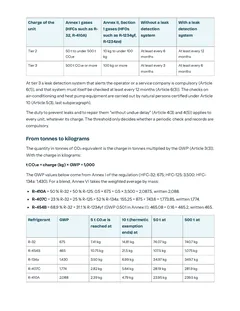
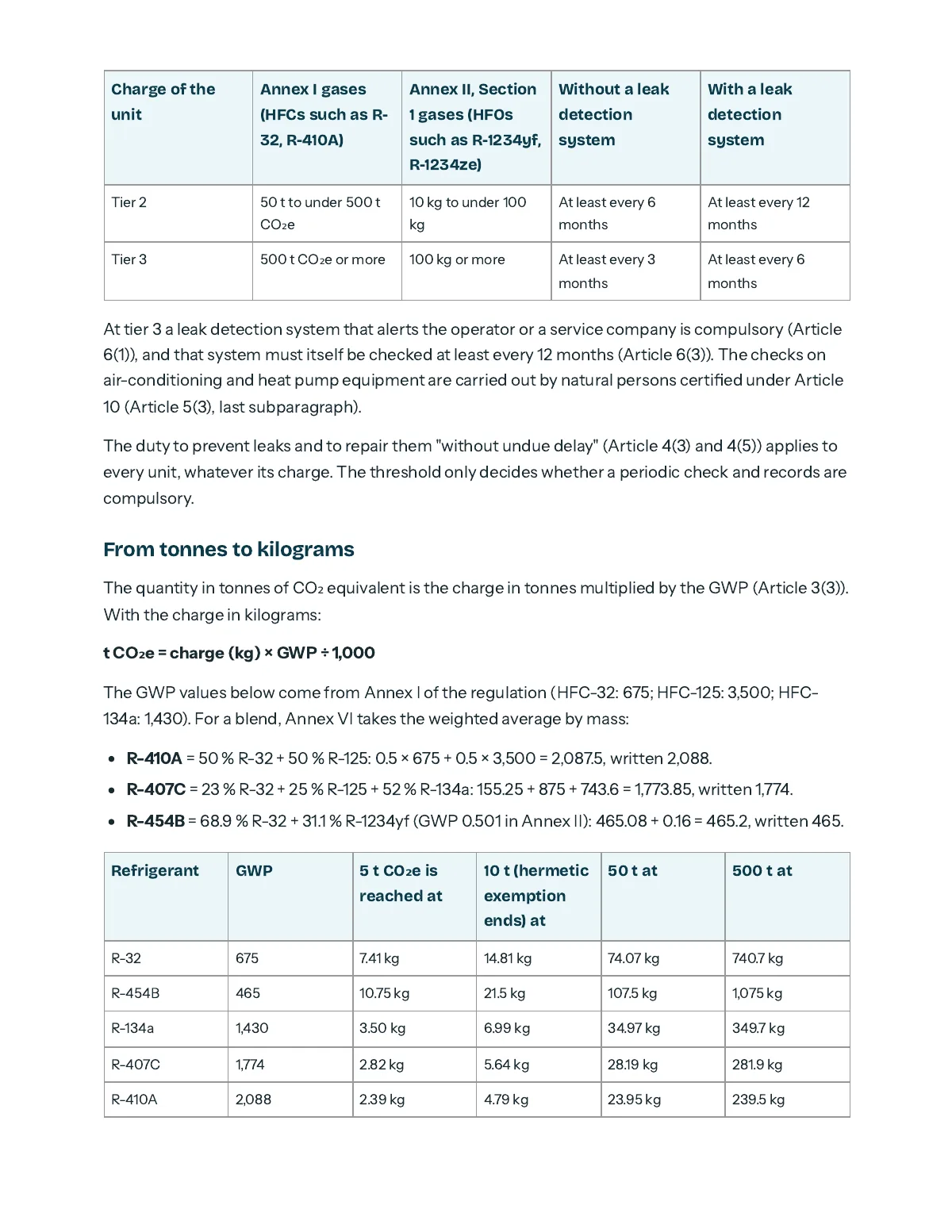
- The F-gas leak-check thresholds in kilograms: the 5, 50 and 500 tonne lines converted for R-32, R-454B, R-134a, R-407C and R-410A, the 1, 10 and 100 kg lines for HFOs such as R-1234yf and R-1234ze, the exemptions for hermetically sealed units, and an eight-unit portfolio worked out.
- The equipment register: what Article 7 requires, the register column by column, how to fill it in one afternoon, and the documents to keep for each unit.
- The maintenance calendar: filters, service and specific points for wall splits, multi-splits, cassettes, ducted units, VRF, monoblocs, portables, rooftop units and small chillers, and a year on one page.
- National rules: the inspection of systems above 70 kW in every EU country, France (every two years from 4 kW), Spain (the RITE intervals for homes and other uses) and Great Britain.
- Three maintenance contracts compared: what the contract must contain, the 12 questions to send to each company, a weighted scoring grid and five warning signs.
- A model specification and a model intervention report, ready to fill in, and how to read a report in two minutes.
- Leaks and recharges: what the regulation requires once a leak is found, the leak log, the annual leak rate per unit, and a repair-or-replace grid.
Free guides or the printable guide
The free articles answer one question at a time. The guide puts it all in order and gives you the tools to act.
Free guides
€0
56 free articles
- ✓The rules explained, official sources cited
- —The decisions in order, from diagnosis to action
- —18 worksheets and tables to fill in
- —2 spreadsheets ready to fill in
- —Print it or keep it as a PDF
Multi-unit maintenance kit
€39
VAT included, paid once
- ✓The rules explained, official sources cited
- ✓The decisions in order, from diagnosis to action
- ✓18 worksheets and tables to fill in
- ✓2 spreadsheets ready to fill in
- ✓Print it or keep it as a PDF
As described, or refunded in full
Who it is for
- Landlords with air conditioners or air-to-air heat pumps in several flats or houses, who want to know which units need a legal leak check, which only need servicing, and who pays for what
- Small businesses (shops, offices, restaurants, surgeries, small hotels) that run splits, multi-splits, cassettes, ducted units or a VRF system and want one register, one calendar and one maintenance contract that covers everything
- Managing agents and co-ownership boards responsible for a shared system, and anyone about to ask three companies for an annual maintenance contract
Contents
- Who is responsible for what free below
- F-gas leak checks: the thresholds in kilograms
- The equipment register
- The maintenance calendar by type of unit
- National rules on top of the EU rules
- Comparing three annual maintenance contracts
- A model specification for your maintenance tender
- A model intervention report
- Leaks and recharges: tracking and deciding
In the paid chapters: 27 checkpoints to tick, and 18 worksheets or tables across the guide, each based on the rule or data it cites.
Introduction
One air conditioner is a household appliance. Five, ten or thirty of them, spread over flats you let, a shop, an office floor or a building you manage, are an asset you operate. The questions change. Which of these units does European law require you to have checked for leaks, and how often? Who is "the operator" when the unit sits in a flat you let, or on the roof of a building you share? What records must you keep, and for how long? What should an annual maintenance contract cover, and how do you compare three offers that are written in three different ways?
This kit answers those questions in order. It starts from the rule that applies everywhere in the European Union, Regulation (EU) 2024/573 on fluorinated greenhouse gases, and converts its thresholds, written in tonnes of CO₂ equivalent, into the kilograms printed on the nameplate of your units, for the refrigerants you are likely to find (R-32, R-410A, R-407C, R-134a, R-454B and the newer HFOs). It then adds the building rules that sit on top: the inspection of systems above 70 kW under the energy performance of buildings directive, and the national maintenance rules of France, Spain and Great Britain, quoted from their texts.
How to use it: read chapter 1 to settle who is responsible for each unit. Chapter 2 tells you which units need a legal leak check and how often. Chapter 3 builds your equipment register, unit by unit, and chapter 4 gives the maintenance calendar by type of unit. Chapter 5 sets out the national rules that apply on top. Chapter 6 helps you compare three annual maintenance contracts, with the 12 questions to ask each company. Chapter 7 is a model specification to send them, chapter 8 a model intervention report to demand after each visit, and chapter 9 the way to track leaks and recharges and to decide when a unit should be replaced. Print it (Ctrl+P or Cmd+P, then "Save as PDF", or print on paper). The equipment register and the contract comparison grid are also on your access page as spreadsheets.
The rules were checked on November 5, 2026 against the official texts listed in the Sources: the Official Journal text of Regulation (EU) 2024/573 and Directive (EU) 2024/1275 on EUR-Lex, the Spanish RITE on the BOE, and the GOV.UK guidance for Great Britain. Every conversion from tonnes to kilograms is calculated in front of you, with the global warming potential (GWP) given in Annex I of the regulation.
Chapter 1: Who is responsible for what
Before any calendar or contract, settle one question for each unit: who is responsible for it. The F-gas regulation puts its duties (leak checks, repairs, records, recovery of the gas) on the operator. Lease law, building law and your contracts decide who pays and who must give access. These are not always the same person, and most disputes start in the gap between them.
The operator, as the regulation defines it
Regulation (EU) 2024/573, Article 3(5), defines the operator as "the undertaking exercising actual power over the technical functioning of products, equipment or facilities covered by this Regulation, or the owner designated by a Member State as being responsible for the operator's obligations in specific cases".
Two things follow from that sentence. First, the test is practical: who actually controls how the unit runs, who decides when it is serviced, repaired or replaced, and who lets technicians in. Second, a Member State may designate the owner as responsible in specific cases, so the national rule can settle the question for you. The GOV.UK guidance for Great Britain puts the rental case plainly: "If you rent out equipment, you may be responsible for leak checks rather than the end user, depending on the rental agreement."
A maintenance company does not become the operator because it services the unit. It carries out the work and keeps its own copy of the records (Article 7(2)(b)), but the duty to have the unit checked, repaired and recorded stays with the operator.
Six common situations
| Situation | Usually the operator | What to put in writing |
|---|---|---|
| A split you supplied in a flat you let, tenant uses it day to day | You, as landlord, when you decide on servicing, repair and replacement; check your national rule | Who cleans the filters, who books the professional visit, who pays, how the tenant reports a fault, access for the technician |
| A unit the tenant installed in a flat with your consent | The tenant, who owns it and controls it | Consent conditions: certified installer, records handed to you, removal and making good at the end of the lease |
| A shop or office leased with the landlord's system | Depends on the lease: the landlord if the system is a building service the landlord maintains, the tenant if the lease hands over operation and maintenance | The maintenance clause: who contracts the maintenance company, who receives the reports, who pays repairs above a set amount |
| A commercial tenant's own units on a leased building | The tenant | Landlord's consent for the outdoor units, position, noise, roof access, removal at the end |
| A shared system in a co-owned building (one VRF serving several units, or units on common parts) | The co-ownership, acting through its board or managing agent | The general meeting decision, the maintenance contract, how costs are shared, who holds the records |
| A business owner's own units in premises it owns | The business | Nothing to split; the register and the contract do the work |
Where your situation does not fit, ask the three practical questions: who can grant a technician access to the unit, who controls its day-to-day running, and who decides and pays for technical changes. If the answers point to different people, write down who is the operator and get the other party to sign it.
What each party does in practice
| Task | Operator | Occupant (tenant, staff) | Maintenance company |
|---|---|---|---|
| Keeping the equipment register | Yes, for every unit | No | Supplies the data after each visit |
| Booking the legal leak checks on time | Yes | Gives access | Carries them out, with a certified technician |
| Repairing a leak without undue delay | Yes, orders and pays (or recharges under the lease) | Reports the symptoms quickly | Locates and repairs, re-checks |
| Keeping records 5 years | Yes (Article 7(2)(a)) | No | Keeps its own copies 5 years (Article 7(2)(b)) |
| Cleaning filters, keeping the drain clear and the outdoor unit unobstructed | Organises it, or delegates it in writing | Often the occupant in a dwelling, under the lease and local custom | On each visit, and between visits if the contract says so |
| Recovery of the gas at the end of life | Yes, through a certified technician | No | Recovers, records the quantity and the destination |
When the unit is in someone's home
A dwelling adds two constraints. The occupant must let the technician in, so the lease should state how much notice is given and what happens if access is refused. And day-to-day care (filters, drain, a clear outdoor unit) is often the occupant's job under national rules on minor repairs, while the professional visit and repairs stay with the owner. France, for instance, puts routine upkeep and minor repairs on the tenant (loi du 6 juillet 1989, article 7, and décret n° 87-712) and replacement and major repairs on the landlord. Chapter 5 gives the national maintenance rules; the split between landlord and tenant is a matter of lease law in each country, and the clause below lets you write it down whatever the country.
A clause to adapt for a lease or a management agreement
"The air-conditioning unit(s) listed in the attached schedule [unit IDs from the register] are operated by [name], who arranges and pays for professional maintenance [at least every … months] and for any leak check required by Regulation (EU) 2024/573, and keeps the records. The occupant cleans the indoor filters [every … weeks during use], keeps the drain and the outdoor unit clear, reports any fault, water leak, ice, noise or loss of cooling within [… days], and gives access to the technician on [… days'] notice. Repairs caused by misuse are charged to the occupant; all other repairs and replacements are borne by [name]. Only technicians holding a valid F-gas certificate may work on the refrigerant circuit."
Check the clause against your national lease law before you use it: some countries cap what may be charged to a residential tenant.
Your responsibility map (fill in)
| Unit ID | Where | Who uses it | Operator | Who pays servicing | Who pays repairs | Access arranged by | Written in (lease, contract, minutes) |
|---|---|---|---|---|---|---|---|
With this map done, chapter 2 tells you which of these units must be checked for leaks by law.
Checkout by Stripe
Card, Apple Pay or Google Pay on Stripe’s secure page. Your card details never pass through our servers.
Instant access
Your guide opens right after payment, ready to save as a PDF. Receipt by email; “Find my purchases” resends the link.
VAT included, paid once
The price shown is the total. No subscription, nothing charged later.
Sources you can check
4 official sources cited in this guide. We install nothing and sell no equipment. Terms of sale.
Frequently asked questions
How do I receive the guide?
Right after payment you are taken to your guide page, with the spreadsheet to download. Bookmark it: the link stays valid and always shows the latest version. To keep a PDF, save it from your browser (Ctrl+P or Cmd+P, then "Save as PDF"): the layout is made for printing. Stripe emails you the receipt, and "Find my purchases" at the bottom of every page sends the link again.
Is VAT included? Is it a subscription?
€39 is the total you pay, VAT included, once. There is no subscription and nothing is charged later. Your card details go to Stripe and never reach us.
I only have three or four units. Is it worth it?
Yes, if they are in different places or used by other people: chapter 2 tells you in five minutes whether any of them needs a legal leak check, and the register and the contract grid work the same for three units as for thirty. With a single split in your own home, our free guide to air conditioning maintenance in Europe is enough.
My country is not among France, Spain and Great Britain. Is it useful?
Yes. The F-gas rules of chapters 1 to 3 and 9 come from Regulation (EU) 2024/573, which applies in the same way in every EU country, the inspection rule above 70 kW comes from the buildings directive, and the calendar, the contract grid and the templates of chapters 4 and 6 to 8 do not depend on the country. For national maintenance rules, chapter 5 ends with the questions to ask, which your maintenance company should answer in writing in its offer.
Does it tell me how to do the leak check myself?
No. Leak checks and any work on the refrigerant circuit are reserved to certified technicians. The kit tells you which units need a check, how often, what the report must contain and what to do when a leak is found, so you can organise the work and check that it was done.
Is it legal advice?
No. It quotes the texts and shows how they apply to common situations; who is the operator in a particular lease, or how your authority reads a rule, can depend on the facts and on national law. For a dispute, ask a lawyer or your national F-gas authority.
What is the guarantee?
The guide is guaranteed as described: if it does not open or contains an error, we fix it, and if we cannot, we refund you in full (refund policy in the terms of sale). Write to admin@tech-bharat.com. A duplicate payment is always refunded.
Free guides on the same topic
- Air conditioning maintenance in Europe: rules, rhythm and real jobs
- The F-gas Regulation 2024/573: what changes for cooling in Europe
- Does an air conditioner need regassing? Refrigerant, leaks and EU rules
All printable guides and packs
€39 is the total you pay, VAT included: nothing is added at checkout. Payment by Stripe; your statement shows “CLAUDE AC”. See our terms of sale, which include our refund policy. Access is immediate after payment. Claude AC is an information publisher; the guide is not legal, engineering or financial advice.