Venting a portable air conditioner through a European window
Contents (7)
The box promises an appliance that needs no installation. About twenty minutes after unpacking it, most European buyers discover that it needs one thing after all: a hole to the outside, made in a window that was never designed to accept one. Portable air conditioners are engineered around the American sash window, which slides up and leaves a tidy horizontal slot for a plastic panel. Germany has tilt-and-turn casements, France has inward-opening French windows, Britain has sashes but also side-hung casements, Spain has sliders behind shutters, and a converted loft has a pivoting roof window. What you do about that gap decides how much of the machine you actually get — in a badly vented room, a large share of the cooling you paid for never arrives.
Why the hose is not a detail
A single-duct portable — the overwhelming majority of what Europe sells — takes air from the room, drives it across the hot condenser and pushes it out of the window. Several hundred cubic metres an hour leave the flat that way, and the room cannot hold a vacuum. Exactly the same volume comes back in: under the front door, through the letterbox, past the trickle vents, around the very window you are venting through, and it arrives from wherever the air is hottest. That return flow is the structural weakness of the category, quantified against fixed systems in our comparison of portable versus split air conditioners.
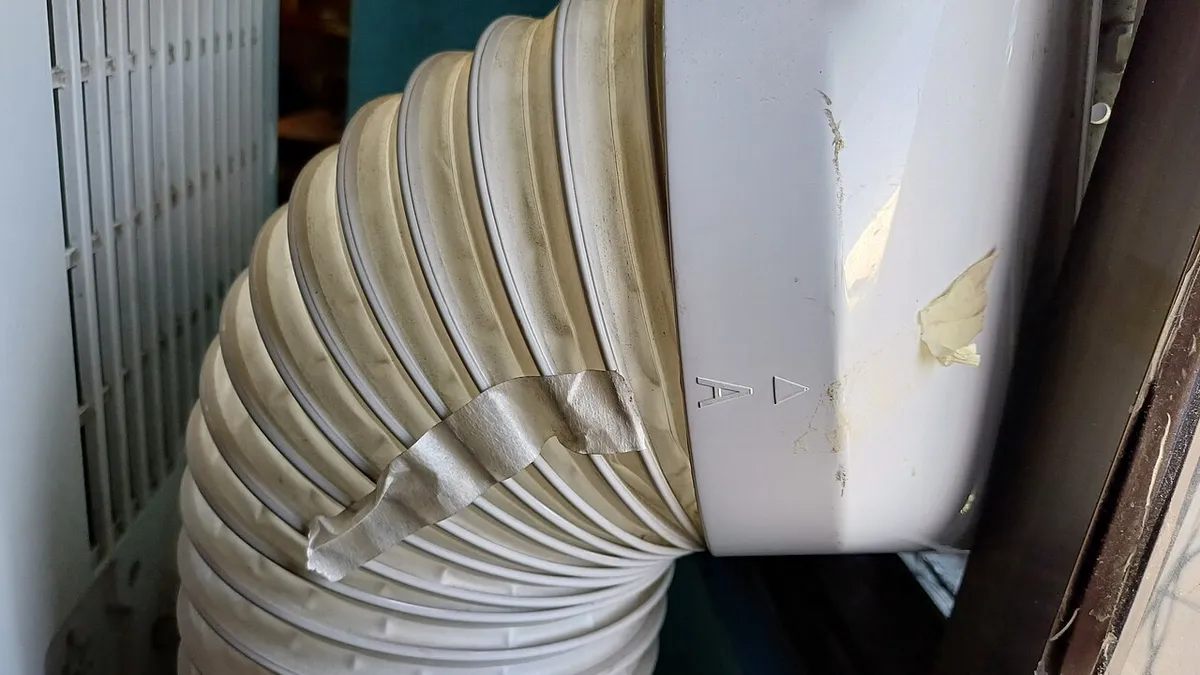
Two things follow, and they are the whole of this guide. First, the quality of the seal around the hose matters more than any specification you compared before buying, because an open gap lets the expelled heat come straight back in and short-circuits the machine. Second, the hose itself is a radiator: it carries air at roughly 45 to 55 °C across your room, and every metre of it that is long, coiled or uninsulated puts heat back into the space the compressor is trying to cool.
The window you have decides the kit you need
| Window type | Common in | What actually works | The trap |
|---|---|---|---|
| Tilt-and-turn (Dreh-Kipp) | Germany, Austria, Poland, Czechia, Netherlands, Nordics | A rigid outlet plate made for the tilted gap, or a zipped fabric seal cut for the tilt position | A tilted sash leaves two open triangles at the sides, not a slot — a round hose alone covers almost none of it |
| Inward-opening casement or French window | France, Belgium, Italy | A zipped fabric seal around the whole opening, or a board cut to the frame with a 150 mm collar | The open sash sits in the room; a seal must never block the window as an escape route |
| Vertical sash | United Kingdom, Ireland | The bundled slider panel finally fits; acrylic or plywood cut to the sash width works better | Old sash boxes are draughty — add self-adhesive foam along the meeting rail |
| Sliding window or balcony door | Spain, Portugal, Greece, southern Italy | A panel in the track, full height for a door, in a rigid material | Fabric over a 2 m opening sags and flaps; and the panel must clear the persiana runners |
| Roof window in a converted loft | Everywhere lofts are habitable | A seal kit for a pivoting sash, hose supported so it rises then falls outside | Hot exhaust released just below a top-hung sash is partly drawn straight back in |
| No usable opening | Internal rooms, listed façades | A core-drilled wall vent with a closable outside grille | This is building work: consents apply, and it is no longer a « no installation » appliance |
Two accessories cover most of Europe. A zipped fabric seal — a coated sheet fitted to the frame with hook-and-loop tape, with a zip the hose passes through — is cheap, removable in September, tolerant of odd shapes, and the sensible default for a rented flat. A rigid cut panel in 6 to 10 mm acrylic, plywood or foamed PVC seals better, insulates better and takes the hose weight; it is the right answer if the same window will be used every summer.
What a good seal is worth
Put rough numbers on it. A tilted casement with a hose laid in the gap and nothing else leaves something on the order of a tenth of a square metre open, right beside a jet of 50 °C air, on the hottest façade of the building. You are not merely losing conditioned air — you are re-importing the heat you just paid to expel. Nobody can promise a specific number of degrees, because it depends on the gap, the façade and the wind; what is safe to say is that sealing is the cheapest performance upgrade available for a portable, and it costs a small fraction of the electricity discussed in our guide to what air conditioning costs to run in Europe.
Five rules for the hose
- Keep it short. Use the length you need and no more. Manufacturers specify roughly 1.2 to 2 m for a reason, and extending it raises back-pressure on the condenser fan, which lowers capacity and can trip the machine into a high-pressure cut-out.
- Keep it straight and rising. Bends and sags shed heat inside the room and collect condensate. A gentle continuous rise to the window is the goal.
- Insulate it. A sleeve of pipe insulation or a purpose-made hose jacket stops the duct behaving as a room heater. It is the second cheapest upgrade after the seal.
- Do not run it through a closed door into a hallway. The heat is then inside the dwelling, and the pressure difference simply pulls it back to you.
- Never vent into a roof space, a suspended ceiling or a chimney flue. A loft becomes a heat and moisture trap above your bedroom, and a flue shared with any combustion appliance must never be used for anything else.
Dual-duct machines, and why Europe rarely sells them
A double-duct portable draws its condenser air from outside through a second hose and returns it outside, so it does not depressurise the room and does not import hot air through the building envelope. Physically it is the better design, and EU labelling recognises the distinction: single-duct and double-duct appliances are measured differently under the ecodesign rules for air conditioners, which is why their headline figures are not directly comparable. In practice, European ranges are dominated by single-duct units because they are cheaper and because two hoses need a wider opening than a tilted casement offers. If your window can accept a proper panel with two collars, a dual-duct machine is the better purchase; if you are sealing a tilted sash, it usually is not an option.
When venting properly is impossible
Some rooms defeat every kit: a listed façade, a window that must stay closed for security, an internal bedroom. A fixed wall monobloc keeps its entire refrigerant circuit indoors and needs only two core-drilled holes — the permanent version of the same idea, done properly, with the trade-offs set out in our guide to air conditioning without an outdoor unit. A split system removes the problem entirely by rejecting the heat outdoors, at the price of consents and a certified installer. The rest of the portable category is covered on our portable air conditioner hub.
Frequently asked questions
Can I use a portable air conditioner without venting it?
No. The hose is not an accessory, it is the machine’s heat rejection. Run a portable with the hose indoors and the condenser heat plus the compressor’s own electrical input stay in the room, so the space ends up warmer than before. Anything sold as a « ventless air conditioner » is an evaporative cooler, which is a different machine with a different physical limit.
How do I vent through a tilt-and-turn window?
Tilt the sash, then close the opening rather than the hose. Either fit a rigid outlet plate designed for the tilted gap — several are sold for 150 mm hoses and let the window stay locked — or fit a zipped fabric seal cut to the tilt geometry. The side triangles are the part people forget; foam strip or offcuts finish them off.
Is the fabric window seal kit worth buying?
For most European windows it is the single best value accessory in the category: it turns an open gap into a closed loop, fits shapes a moulded panel never will, and comes off in September. A rigid cut panel seals and insulates better and is preferable if the installation is going to repeat every summer.
Can I make the hose longer to reach a distant window?
Avoid it. Longer and wider-radius ducting raises resistance, cuts airflow across the condenser, reduces cooling capacity and can trigger a protective shutdown; it also radiates more heat into the room on the way. Moving the unit closer to the window is almost always the better answer, and if that is impossible the room is telling you it wants a fixed system.
Does insulating the hose actually make a difference?
Yes, and it is measurable with nothing more than your hand: an uninsulated duct is uncomfortably hot along its whole length, and that heat is being delivered to the room you are cooling. A closed-cell sleeve costs very little and removes it. Do the seal first, the insulation second.
Sources
Read next
- Heating with your air conditioner through a European winter
- The room under the roof: cooling a loft conversion in Europe
- How far can the outdoor unit sit from the indoor unit?
- Air conditioning that has stopped cooling: the European diagnosis order
- How long an air conditioner lasts in Europe, and when replacing beats repairing