Who Pays When Your AC Breaks: The Warranty, Home Warranty and Insurance Claims Workbook (2026)
A 10-chapter workbook you read online or print, with a warranty register and claim log spreadsheet, for US homeowners with a central AC, a heat pump or a mini-split: know who pays when it fails and get the claim paid.
- 10chapters
- 19worksheets and tables
- 49checklist items
- 17official sources cited
Checked before every release
- 54automated testsrun at every release: prices, links, pages and data checked before publication.
- 17primary sourcesevery rule and number linked to the official text, for you to open.
- October 23, 2026editionrules and numbers checked on this date, updated when a text changes.
Built from the texts and data of FTC, Code of Federal Regulations, EPA.
When an air conditioner or a heat pump fails, the first question is who pays. Four different promises can cover the same machine: the manufacturer’s parts warranty, the installer’s labor warranty, a home warranty contract and your homeowners policy. Each has its own clock, its own exclusions and its own paperwork. Most denied claims are not unfair: they follow a registration never done, a transfer never filed or a claim sent to the wrong party.
Every rule is quoted with its source (the Magnuson-Moss Warranty Act and the FTC’s rules, HUD, state laws, the manufacturers’ published warranty terms, the NAIC) so you can check it. We do not repair, install or sell equipment and take no commission from contractors, manufacturers, home warranty companies or insurers: the workbook is on your side.
$24
Get the guide, $24Read chapter 1 free- 10 chapters (about 7,400 words): the four promises, manufacturer registration, new homes, installer labor, home warranty contracts, homeowners insurance, buying or selling a house, the claim playbook, denials and appeals, your file
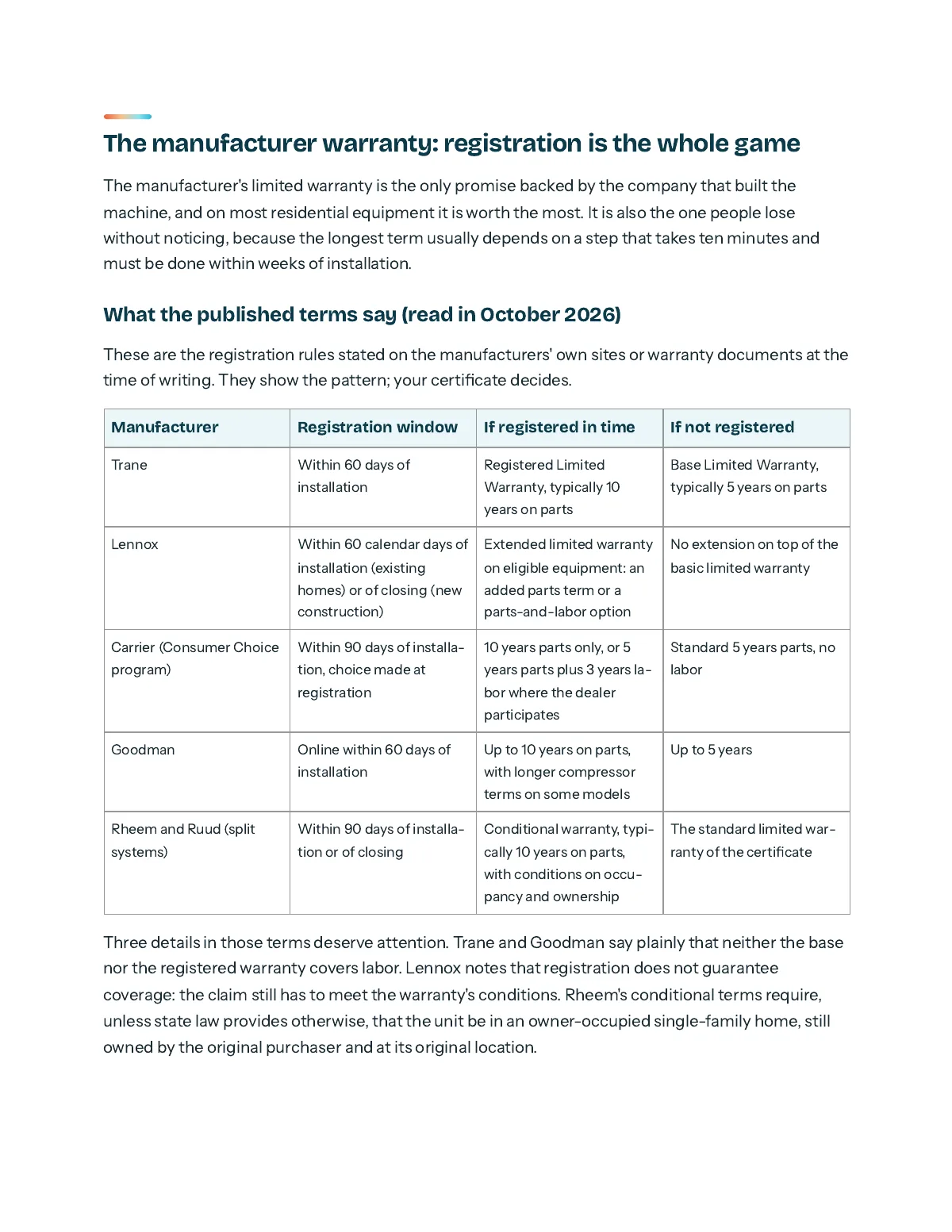
- 19 worksheets and reference tables, including the registration rules published by five manufacturers, a home warranty clause check and claim letters
- One spreadsheet (CSV: Excel, Numbers, Google Sheets): warranty register and claim log
Instant access: right after payment your guide opens in your browser; print it or save it as a PDF. $24, paid once, no subscription.
As described, or refunded in full · written into our terms of sale
For $65 more: US Homeowner AC Library 2026, 5 guides, $17.80 per guide.
Secure checkout by Stripe (card, Apple Pay, Google Pay), one-time payment with no subscription, instant access. Refund policy
What you get
- The map of the four promises: manufacturer, installer, builder, home warranty and insurance, with what each pays and never pays.
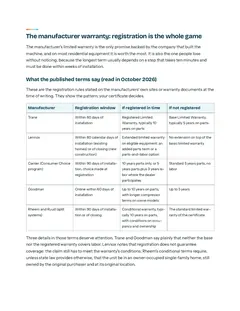
- Registration rules as published by Trane, Lennox, Carrier, Goodman and Rheem, the states where registration cannot be required, and a day-one checklist.
- New homes: the builder warranty (the 1-2-10 structure, HUD form 92544 for FHA loans, New Jersey’s law) and when the equipment warranty starts at closing.
- Installer and extended labor plans: what to get in writing and a comparison sheet.
- Home warranty contracts: how states regulate them, the five clauses that decide an AC claim, old systems, replacement requests and a pre-signing checklist.
- Homeowners insurance: peril or breakdown, water from the AC, actual cash value or replacement cost, percentage deductibles, code upgrades, equipment breakdown cover.
- The claim playbook: which party to call first, a diagnosis that names the cause, and claim notice templates.
- Denials and appeals: reasons matched to evidence, an appeal letter, regulators by type of promise, and your rights under federal law.
Free guides, this guide or the library
The free articles answer one question at a time. The guide puts it all in order and gives you the tools to act.
Free guides
$0
59 free articles
- ✓The rules explained, official sources cited
- —The decisions in order, from diagnosis to action
- —19 worksheets and tables to fill in
- —A spreadsheet ready to fill in
- —Print it or keep it as a PDF
- —All 5 guides for US homeowners in one purchase
Warranty & claims workbook
$24
paid once
- ✓The rules explained, official sources cited
- ✓The decisions in order, from diagnosis to action
- ✓19 worksheets and tables to fill in
- ✓A spreadsheet ready to fill in
- ✓Print it or keep it as a PDF
- —All 5 guides for US homeowners in one purchase
US Homeowner AC Library 2026
$89
5 guides, $145 bought one by one (you save $56)
- ✓The rules explained, official sources cited
- ✓The decisions in order, from diagnosis to action
- ✓19 worksheets and tables to fill in
- ✓A spreadsheet ready to fill in
- ✓Print it or keep it as a PDF
- ✓All 5 guides for US homeowners in one purchase
As described, or refunded in full
In pictures
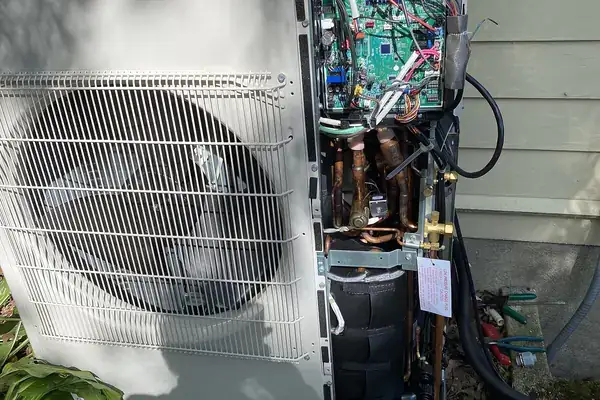



Illustrative photos, published by their authors under free licences.
Who it is for
- US homeowners who just had a central AC, heat pump or mini-split installed and want every year of coverage they are entitled to
- Buyers of a new-construction or resale home who want to know what warranty actually comes with the HVAC system, and how to keep it
- Owners facing a failure right now, with a manufacturer warranty, a home warranty contract or a homeowners policy, who want to know which one pays and how to claim
Contents
- Four promises, one machine: the map free below
- The manufacturer warranty: registration is the whole game
- New homes: the builder warranty and the equipment warranty
- The installer's warranty and extended labor plans
- Home warranty contracts: reading one before August
- Homeowners insurance: perils, not breakdowns
- Buying or selling a house: keep the coverage
- When it breaks: the claim playbook
- Denials, appeals and complaints
- Your warranty file, register and claim log
In the paid chapters: 49 checkpoints to tick, and 19 worksheets or tables across the guide, each based on the rule or data it cites.
Introduction
When an air conditioner or a heat pump fails, the first question is rarely technical. It is: who pays? Four different promises can apply to the same machine, written by four different parties, each with its own clock, its own exclusions and its own paperwork. The manufacturer covers defective parts, often for twice as long if the equipment was registered in time. The installing contractor covers the installation itself, usually for a short period. A home warranty company may have sold a service contract that pays for breakdowns up to a cap. And the homeowners insurer pays for damage caused from outside, such as hail, lightning or a falling tree, but never for wear.
Most denied claims are not unfair. They are the predictable result of a registration that was never done, a transfer that was never filed, a maintenance history nobody can prove, or a claim sent to the wrong party. This workbook is the owner's side of that paperwork: what each promise really covers, how to keep it alive, and what to do, in order, the day something breaks.
How to use it: if your system is new or you just bought the house, do chapters 2, 3 and 7 this week and fill in the warranty register in chapter 10. If something has failed, go straight to chapter 8, then to the chapter of the promise that applies (2 to 6), and to chapter 9 if the answer is no. Print it (Ctrl+P or Cmd+P, then "Save as PDF", or print on paper) and keep it with your house papers. The warranty register and the claim log are also on your access page as a spreadsheet.
The rules quoted come from named sources: the Magnuson-Moss Warranty Act (15 U.S.C. 2301 and following) and the FTC's rules and guidance on it (16 CFR parts 700 to 703), the FTC's consumer pages on warranties and home warranties, HUD's builder warranty requirement for FHA-insured new homes, state laws given as examples (California, Florida, New Jersey, Texas), the published warranty and registration terms of several major equipment manufacturers as read in October 2026, the NAIC's consumer guidance on insurance settlements, and the EPA's refrigerant transition rules. Manufacturer terms change and vary by model: where this workbook quotes one, treat it as an example and check the certificate for your own equipment.
Chapter 1: Four promises, one machine: the map
Before reading any document, put each promise in its box. The single most common mistake is to send a claim to the wrong party: asking the insurer to pay for a worn-out compressor, or the manufacturer to pay for the labor to replace it.
Who promises what
| Promise | Who gives it | What it is for | What it never pays for |
|---|---|---|---|
| Manufacturer limited warranty | The equipment maker | A part that fails because of a defect in materials or workmanship | Labor in most cases, refrigerant, damage from outside, failures caused by installation or lack of maintenance |
| Installation (labor or workmanship) warranty | The installing contractor | Mistakes in the installation, and often the labor to replace a covered part for a short period | Anything after its term; parts (those are the manufacturer's) |
| New-home builder warranty | The builder of a newly built house | Defects in the house, including the design and installation of the HVAC system, for a limited time | Normal wear, damage caused by the owner, and anything past its term |
| Home warranty (service contract) | A home warranty company you or the seller paid | Repair or replacement of covered systems that break down, up to stated limits | Pre-existing conditions, items above the cap, standard exclusions written in the contract |
| Homeowners insurance | Your insurer | Sudden, accidental damage from a covered peril (hail, wind, lightning, fire, theft, a falling tree) | Wear and tear, mechanical breakdown, lack of maintenance, flood without a flood policy |
| Equipment breakdown endorsement (if you bought one) | Your insurer, as an add-on to the policy | Sudden mechanical or electrical breakdown of covered home systems | Wear the endorsement excludes, and amounts above its sublimit |
The two federal words that matter
The Magnuson-Moss Warranty Act sorts written consumer warranties into two kinds, and every manufacturer warranty you will meet on residential HVAC equipment is labelled one of them.
- A full warranty meets the federal minimum standards. Among them, the FTC explains that a full warranty may not impose duties beyond notifying the warrantor, and that requiring the return of a registration card is an unreasonable duty that is not allowed in a full warranty. A full warranty also cannot limit how long implied warranties last.
- A limited warranty is anything that does not meet those standards. It can require registration, exclude labor and limit the duration of implied warranties to its own duration.
Residential air conditioners and heat pumps are almost always sold with a limited warranty. That is why registration can legally change the term on your equipment, except in states whose law says otherwise (chapter 2).
Warranty or service contract?
The FTC draws a sharp line: a warranty comes with the product and is part of its price; a service contract (including an "extended warranty" and a "home warranty") costs extra and is sold separately. A service contract is not titled "full" or "limited", and it is a different legal object, mostly regulated by the states. Keep the two apart in your file and in your head.
Your map (fill in today)
| Promise | Do I have it? | Who to call | Term ends | Document location |
|---|---|---|---|---|
| Manufacturer warranty, outdoor unit | ||||
| Manufacturer warranty, indoor unit or furnace | ||||
| Installer labor or workmanship warranty | ||||
| Builder warranty (new home) | ||||
| Extended labor or service plan | ||||
| Home warranty contract | ||||
| Homeowners policy, and equipment breakdown endorsement |
Also in the US Homeowner AC Library 2026: 5 guides for US homeowners in one purchase, $89.
Checkout by Stripe
Card, Apple Pay or Google Pay on Stripe’s secure page. Your card details never pass through our servers.
Instant access
Your guide opens right after payment, ready to save as a PDF. Receipt by email; “Find my purchases” resends the link.
One price, paid once
The price shown is the total, in US dollars. No subscription, nothing charged later.
Sources you can check
17 official sources cited in this guide. We install nothing and sell no equipment. Terms of sale.
Frequently asked questions
How do I receive the guide?
Right after payment you are taken to your guide page, with the spreadsheet to download. Bookmark it: the link stays valid and always shows the latest version. To keep a PDF, save it from your browser (Ctrl+P or Cmd+P, then "Save as PDF"): the layout is made for printing. Stripe emails you the receipt, and "Find my purchases" at the bottom of every page sends the link again.
Is it a subscription? Is anything added at checkout?
$24 is the total you pay, once. There is no subscription and nothing is charged later. Your card details go to Stripe and never reach us.
I just bought a house. Can I still get the manufacturer warranty?
Often yes, but the rules differ by brand: some transfer only a registered warranty within a deadline after the sale, sometimes for a fee, and some revert to a shorter term. Chapter 7 shows the published terms and gives a letter to send with the serial numbers.
Does it tell me which home warranty company or insurer to choose?
No. We recommend no company. The workbook gives the clauses and limits to read, and the checklists to compare the contracts and policies you are offered.
What is the guarantee?
The guide is guaranteed as described: if it does not open or contains an error, we fix it, and if we cannot, we refund you in full (refund policy in the terms of sale). Write to admin@tech-bharat.com. A duplicate payment is always refunded.
Free guides on the same topic
- HVAC warranties: the registration deadline that doubles your coverage
- Does a home warranty cover your air conditioner? Reading it before August
- Homeowners insurance and your air conditioner: what a claim actually pays
- Repair or replace your air conditioner: how to make the call
- AC compressor replacement: the repair that is really a system decision
All printable guides and packs
$24 is the total you pay, charged in US dollars: nothing is added at checkout. Payment by Stripe; your statement shows “CLAUDE AC”. See our terms of sale, which include our refund policy. Access is immediate after payment. Claude AC is an information publisher; the guide is not legal, engineering or financial advice.